SPLENDORE E CRISI
Il Cinquecento si apre con il papato di Giulio II (1503-13), il quale affida a Bramante la ricostruzione di S. Pietro e avvia l'apertura di nuovi assi stradali lungo il Tevere, via Giulia e via della Lungara e affida a Michelangelo il compito di affrescare la Cappella Sistina.
In questa pagina:
L'uomo rinascimentale
Papa
Giulio II
(Palazzo dei Tribunali)
Un Cenacolo Romano
Papa Leone X
(1513-1521)
Tra Francia e Spagna - Papa Adriano VI
Papa Clemente
VII e il Sacco di Roma (16
maggio 1527)
Iconografia
L'Uuomo Rinascimentale
Rinascita o Rinascimento è un riferimento al revival di concetti filosofici o
artistici tipici dell'antica Grecia e del mondo Romano. A Firenze un
gruppo di filosofi e di artisti sostenuti da Lorenzo il
Magnifico svilupparono i principi teoretici che sostenevano un nuovo
approccio al ruolo dell'uomo, così che mentre Rinascimento si
riferisce alle arti, Umanesimo è il termine che definisce
l'aspetto filosofico dello stesso movimento.
Marsilio Ficino in particolare
ravvivò la conoscenza dei filosofi Neoplatonici che nel III secolo d.C.
attraverso la rilettura delle opere platoniche, in particolare del Timeo,
credevano che la perfezione umana e la felicità fossero ottenibili in
questo mondo, senza aspettare l'altra vita; la bellezza era un elemento
essenziale del percorso verso l'obbiettivo. Ficino presiedeva un'Accademia
fondata dai Medici nella quale riviveva in qualche maniera la scuola di
Platone; egli fu il precettore di Lorenzo. Entrambi condividevano la
visione che il tempo era maturo per una nuova età dell'oro per le arti:
poesia, pittura, scultura, architettura, musica...
Questa visione era
inserita in una cornice Cristiana, soprattutto per evitare accuse d eresia.
A
voler semplificare, Lorenzo riassunse lo spirito del suo tempo in questi
versi:
| Quant' e bella giovinezza
Che si fugge tuttavia! Chi vuol esser lieto, sia: Di doman non c'e certezza. |
(dal Trionfo di Bacco e Arianna, versi che riecheggiano l'oraziano carpe diem quam minimum credula postero - Odi 1.11).
Il cenacolo Medici, the artistic and literary clique grouped around Lorenzo, non rappresentava l'intera società fiorentina e nel 1494, quando i Medici furono rovesciati, Girolamo Savonarola, un frate domenicano che predicava uno stile di vita molto più austero divenne de facto il capo della Repubblica Fiorentina; quelli della sua parte furono spregiativamente chiamati Piagnoni, ma rimasero al potere tre anni; nel Febbraio del 1497 essi portarono a compimento il Falò delle Vanità: bruciarono in Piazza della Signoria libri, statue, dipinti, strumenti musicali, abiti, specchi e perfino (come moderni Talebani) collezioni di scacchi.
Savonarola predicava contro la corruzione della corte di Papa Alessandro VI; il papa non reagì immediatamente, preferì aspettare l'occasione giusta.
Calendimaggio era una tradizionale festività medievale che si rifaceva alle celebrazioni pagane delle fertilità. A Firenze essa era diventata una sorta di carnevale, celebrata anche in una canzone di Agnolo Poliziano, il principale poeta della corte di Lorenzo:
| Ben venga maggio,
E 'l gonfalon selvaggio! Ben venga primavera, che vuol ch’uom s’innamori; e voi donzelle, a schiera con li vostri amadori, che di rose e di fiori vi fate belle il maggio, venite alla frescura delli verdi arbuscelli. |
Savonarola bandì tutte le celebrazioni di Maggio, ma il suo sermone del giorno dell'Ascensione (4 Maggio) fu fischiato; ci furono dei ribelli: le taverne furono riaperte e tornò il gioco d'azzardo; il 13 Maggio Alessandro VI scomunicò Savonarola e comandò il suo arresto e la sua esecuzione: dopo un processo, durante il quale Savonarola fu torturato, egli fu condannato a morte e nel Maggio 1498 egli fu impiccato e bruciato in Piazza della Signoria dove aveva avuto luogo il Falò delle Vanità.
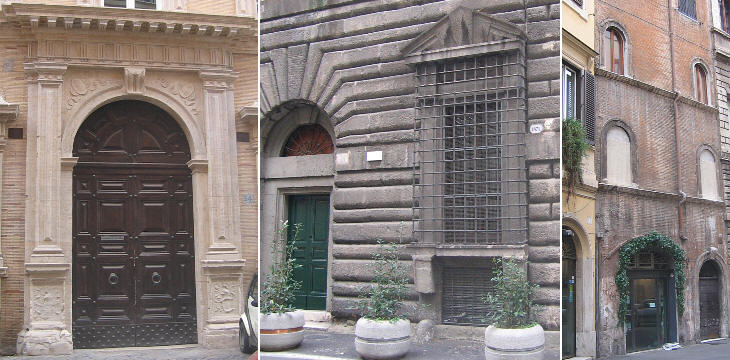
(a sinistra) portone principale di Palazzo di Sora;
(al centro) finestra di Palazzo Vidoni;
(a destra) casa rinascimentale in Via del Governo Vecchio vicino a Palazzo
Nardini
Gli artisti Rinascimentali ammiravano le opere
dell'arte classica, le studiavano, investigavano le loro proporzioni, ma
non le imitavano; mentre nel XVIII secolo e all'inizio del XIX gli
architetti Neoclassici progettavano saloni, tribunali e chiese che avevano
l'aspetto esterno di templi antichi, gli artisti del Rinasciment
"andarono oltre" i modelli classici (vedi la finestra di Palazzo
Vidoni) e anche quando facevano uso di alcuni elementi di questi modelli
li combinavano in nuove maniere (ingresso di Palazzo di Sora): le case
tipiche del Rinascimento erano progettate con lo scopo di ottenere grandi
superficie da usare per graffiti, particolare genere di pittura (vedi
sotto).
Papa Giulio II
Il
18 Agosto 1503 Alessandro VI morì dopo brevissima malattia; Cesare, his
son, was ill too, as well as a cardinal they had lunch with: historians
tend to attribute the death to malaria, also taking into consideration the
season when it occurred, but at the time many thought the pope and his son
had poisoned themselves by mistake with cantarella, an arsenic
based powder they had used to kill their enemies.
Cesare, although ill,
tried to influence the outcome of the conclave; the cardinals
granted that he would retain his possessions in Romagna if he promised not
to interfere with their decision. The cardinals chose not to choose in the
sense that they elected a cardinal who was very ill: Francesco Todeschini
Piccolomini, nipote di Papa Pio II: divenne papa Pio III e il suo
pontificato durò solo 26 giorni.
Durante questo periodo il Cardinal Giuliano della
Rovere, nipote di Papa Sisto IV,
understood that the ailing pope was close to death and he made agreements
with the other cardinals to secure his election in the forthcoming
conclave.
He had a very strong personality and military and
diplomatic skills: his self-esteem was so high that he almost did not
change his name when he was appointed pope: he became Pope Julius
II.
Notwithstanding the assurance he had given to Cesare Borgia prior
to his election, he soon managed to oust him from his possessions, which
in part Venice had occupied, profiting from a revolt in Faenza and
Rimini.
The pope tried to convince the Venetians to return these towns
to the Church, but his diplomatic efforts failed. He then managed to
organize a large coalition (Lega di Cambrai, dal nome della città francese dove ebbero luogo
i negoziati), which included King Louis XII of
France, King Ferdinand II of Aragon and the German Emperor Maximilian I;
it was the beginning of the Italian Wars: four wars which saw the
involvement of almost all the European nations and which ended in 1516 to
start again in 1519 and continue until 1530.
In April 1509 Venice was
attacked on all fronts and in a matter of months it nearly lost all its
Italian possessions: the Venetian Senate sent emissaries to the pope and
by promising to help him in seizing the Duchy of Ferrara, a French ally,
they convinced the pope to agree on a reconciliation.
The next phase of
the war saw the Venetian and Papal troops fighting against the French
ones: the pope hired an army of Swiss mercenaries to attack the French,
but King Louis managed to bribe them and was left free to march towards
Bologna, which in May 1511 was conquered. Pope Julius blamed this defeat
on his nephew, Francesco Maria Della Rovere, Duke of Urbino. The
young duke suspected that his uncle's behaviour was suggested by Cardinal
Francesco Alidosi, a very close friend of the pope: the duke did not
hesitate to stab the cardinal to death. There are two famous portraits of
Francesco Maria della Rovere: one by Raphael painted most likely in 1504
when the duke was fourteen (the duke was portrayed by Raphael also in
The School of Athens): due to the age and the fine features of the
face the duke has a sexually ambiguous look; the second portrait was
painted by Titian in 1532-38: the duke was depicted as a very manly
military leader: the two portraits could not be more different (see the Iconography
section for the links to the works of art mentioned in this page).
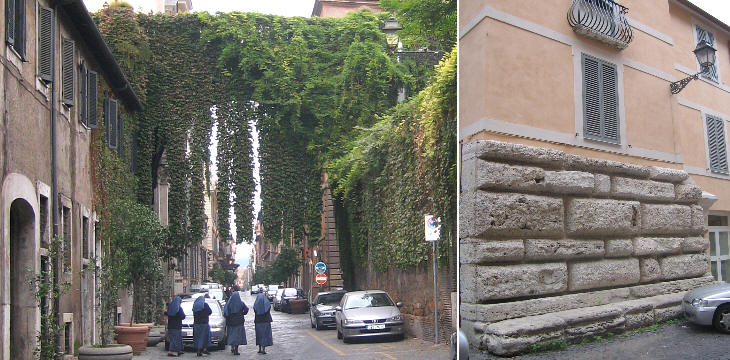
(a sinistra) Via Giulia; (a destra) wall of the never completed Palazzo dei Tribunali
Pope Julius II continued his predecessors' renovation program of Rome of and focussed his attention on the rioni along the river and in particular Regola and Trastevere.
He opened a new street in Regola which was named after him: it provided a direct link between the Florentine quarter in Ponte and Ponte Sisto, the bridge built by his uncle. He wanted to give importance to the new street and he planned to locate there the various Tribunals which existed in Rome: in 1508 he commissioned the new building to Bramante who designed a square courtyard surrounded by a portico and by the offices of the tribunals: the project was abandoned after the death of the pope in 1513 and the area at a later stage was acquired by a brotherhood which built small houses on top of the external walls of the palace conceived by Bramante.
Pope Julius II opened an even longer street on the other bank of the river: Via della Lungara linked Porta S. Spirito with Porta Settimiana: it was called Sub Janiculo because it was located at the foot of that hill: the street continued beyond Porta Settimiana and was called Via Transtiberina because it crossed Trastevere (today it is called Via della Lungaretta).
Un Cenacolo Romano
In June 1511 the French had conquered most of Romagna and Pope Julius II launched a sort of crusade against them: he convinced not only Ferdinand II of Aragon and the German Emperor Maximilian I to declare war on Louis XII of France, but even King Henry VIII joined the alliance (the Holy League) with the aim of expanding the English holdings in northern France. During the initial phase of the war the French held their positions, but by May 1512 they had to retreat to Milan, which was attacked by another Swiss army hired by the pope: this time the mercenaries did not defect and the French had to withdraw across the Alps.
The winners met at Mantua to discuss the partition of the conquered territories, but were unable to reach an agreement; Pope Julius received Modena and Parma and also the assurance that the Spanish troops would overthrow the govenment of the Florentine Republic, which the pope had reproached for having hosted a council promoted by the French. He could not however obtain Ferrara: there were other disagreements among the members of the Holy League, but Pope Julius II did not have any say in the upcoming fourth phase of the war because he died in February 1513.
Pope Julius II was the founder of the Swiss Guard: for this reason the morion (* external link) the guards wear on particularly solemn occasions is decorated with the pope's coat of arms (an oak).
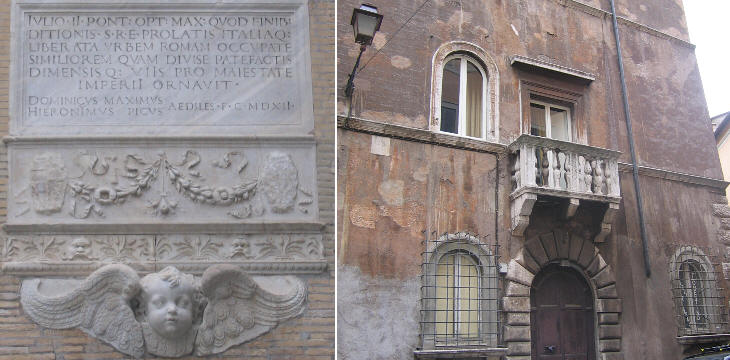
(left) 1512 inscription celebrating Pope Julius II opposite Palazzo del Banco di S. Spirito; (right) Renaissance house in the Florentine quarter opposite S. Giovanni dei Fiorentini
What Lorenzo il Magnifico had been for the Florentine Renaissance, Pope Julius II was for the Roman Renaissance; notwithstanding his personal involvement in the Italian Wars he attracted the most important artists of that period to Rome: Bramante was charged with the design of S. Pietro Nuovo: Pope Julius II laid the first stone of the new basilica on April 18, 1506: work started from the pillar which subsequently became known as that of Veronica: the tomb of St Peter, the papal altar and the choir were protected by Bramante's Tegurium (protection) a temporary building: religious celebrations took place in what was left of the old basilica for more than a century until November 1609 (for an overview of the completion of S. Pietro click here). The pope wanted to be buried in a monument at the centre of the new basilica and in 1505 he commissioned it to Michelangelo, who with his statue of David in Florence had become the most acclaimed Italian sculptor: the monument was never completed, in part due to a controversy between the pope and the artist (according to Michelangelo, Bramante and Raphael were envious of him and spoke badly of him to the pope): the monument (much smaller than originally designed) was eventually placed in S. Pietro in Vincoli. Michelangelo returned to Florence, but the pope wanted him back: the two met in Bologna and Michelangelo accepted a new commission: a titanic challenge for him as Pope Julius asked him to paint the ceiling of the Sistine Chapel: Michelangelo did not regard himself as a painter, but rather as a sculptor: in order to overcome his resistance the pope left him free to paint what he thought worked best, a recognition of an artist's right to follow his inspiration: when eventually in October 1512 the scaffolding was removed and the ceiling became visible the admiration was general and unreserved.
Pope Julius II acquired two ancient statues which greatly influenced Renaissance artists: when he was a cardinal he bought a statue of Apollo which in 1511 he placed in Palazzo del Belvedere, so that the statue became known as Apollo Belvedere; in January 1506 the pope acquired a statue which had just been unearthed on the site of Terme di Tito: it portrayed an event in Virgil's Aeneid (Book 2): the Trojan priest Laocoön and his two sons strangled by sea snakes, sent by the gods who favoured the Greeks, because Laocoön had tried to warn the Trojan citizens of the danger of bringing the wooden horse into Troy.
In 1508 Pope Julius II commissioned to Raphael the decoration of his secret library in the papal apartment in the Vatican palace: the School of Athens, one of the frescoes of this room (known as Stanza della Segnatura) can be regarded as a visual summary of the Renaissance Neoplatonist philosophy.
Il patronato delle arti di Giulio II was supplemented by that of Agostino Chigi, a banker from Siena, who made a fortune with the exploitation of the alum mines at Tolfa: he helped the pope and in return he was appointed treasurer of the Apostolic Camera and he was allowed to add to the mountains of his coat of arms the oak of the Della Rovere. He lived in a sumptuous residence decorated by Raphael on the Via della Lungara opened by the pope. This residence was a gathering point for artists and poets: he and his mistress Imperia, one of the most celebrated Roman courtesans, offered lavish banquets which were followed by philosophical and artistic discussions: he revived in Rome the Florentine Medici cenacle. He also commissioned from Raphael the Chigi Chapel in S. Maria del Popolo. The pope and Agostino Chigi tried to curb the power of the Florentine bankers and new financial institutions were founded in what is called Via dei Banchi Nuovi (to distinguish it from Via dei Banchi Vecchi in the Florentine quarter).
Papa Leone X
Nel conclave che seguì la morte di Papa Giulio II fu eletto papa il Cardinal Giovanni de' Medici. Prese il nome di Leone (X) and many lions were painted or sculptured in Rome to please the pope, but he was not a lion at all. The war in northern Italy entered its fourth phase with the dissolution of the Holy League and a new alliance between France and Venice; Francis I, the new French king, defeated the Swiss in 1515 and conquered again Milan: Leone X met with the king in Bologna and signed the peace although this meant losing Parma and Modena.
In 1517 he did not take seriously the initial acts of Martin Luther, a German Dominican monk who challenged the doctrine of the Church and condemned the behaviour of the Curia.
One of the reasons for the slow and ineffective reaction of the pope lay in the fact that Luther was protected by Frederick the Wise, a German prince who was the pope's candidate for the role of Holy Roman Emperor. King Ferdinand I of Spain died in 1516 and Emperor Maximilian I died in 1519: their heir was Charles, their common grandson (son of Philip the Handsome (of Austria) and Joanna of Castile). Pope Leo X feared that if Charles became emperor he would achieve far too great a power, so to please his candidate he delayed a tough action to repress the views of Luther. It was only after Charles had managed to be elected emperor that Papa Leone X issued the bull Exsurge Domine to excommunicate Luther and his followers.
The election of Charles raised the envy of Francis and a new war broke out in Italy: Pope Leo X made an alliance with Charles V in the hope of having his support against the Lutherans. In November 1521 Imperial and Papal (Swiss) forces defeated the French and forced them to abandon Milan and withdraw from Italy; the pope rejoiced at the news, but just for a few days, because on December 1st he died.
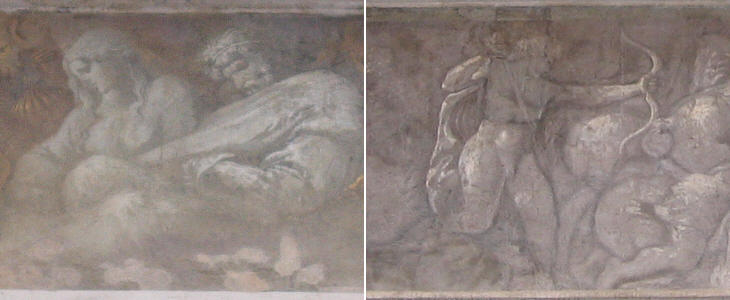
Roma picta (painted Rome): graffiti at
Papa Leone X did not leave room for scandal on moral grounds as his predecessors had done, but his passion for all sorts of entertainment was not appropriate for the spiritual leadership he was expected to exert. Jesters (including some friars) competed to amuse the pope and they had access to his private apartments at any time; another papal leisure activity was to organize parades through the streets of Rome to show off a white elephant presented to him by the King of Portugal.
Raphael continued the decoration of the papal apartment and he portrayed the pope as his great predecessor Pope Leo I in the act of warning Attila not to invade Italy: in another fresco, under the pretext of showing an episode in the life of Pope Leo IV, Raphael portrayed the destruction of Troy and the flight of Aeneas. There was little spiritual breath in these fine works by Raphael; the growing concern for the developments of the Reformation promoted by Martin Luther led Cardinal Giulio de' Medici, cousin of Pope Leo X to ask Raphael to paint for him the Transfiguration of Christ on Mount Tabor: according to Giorgio Vasari who wrote the biographies of the main Renaissance artists ('The Lives of the Most Excellent Painters, Sculptors and Architects'), this painting, Raphael's last, was "the most celebrated, the most beautiful and the most divine".
Painting was so popular that not only the interior of the richest residences was painted, but also the façades were decorated using a particular technique called graffito: usually only black and white were used, but in some cases a touch of gold was added: in its simplest form the graffito was limited to the design of architectural elements such as lintels, frames and pillars, but it sometimes included strips of images: the subjects were mainly taken from the history of Ancient Rome or from mythological accounts.
Pope Leo X followed the steps of his predecessor in opening a new long and straight street which was named after him Via Leonina, but which eventually became known as Via di Ripetta: it linked an area where the Medici had several possessions (Palazzo Medici Lante, Palazzo Madama and Palazzo di Fiorenza) with Piazza del Popolo. He promoted a wide restoration of S. Maria in Domnica and his pontificate saw the initial construction or the modification of several churches: among others S. Luigi dei Francesi, S. Giovanni dei Fiorentini, S. Eligio degli Orefici and S. Marcello al Corso. The palaces which were started during the pontificate of pope Leo X included Palazzo Baldassini, Palazzo Valle, Palazzo Salviati and Villa Madama.
|
Beata Ludovica Albertoni (1474-1533): una femminista del Rinascimento |
Tra Francia e Spagna
Franza o Spagna, purché se magna : this popular saying summarizes the conditions of
Italy in the XVIth century because the country became the main battlefield
in the struggle between King Francis I of France and Emperor Charles V:
the troops involved in the war were mainly soldiers of fortune; they were
faithful only to their leaders who in turn were ready to switch from one
side to the other if they were not paid enough: destruction and looting
affected both northern Italy (where most of the battles occurred) and the
peninsula, as the Spanish troops moved northwards from Naples.
Another
factor in the Italian decline was the growing importance of the oceanic
routes to India and the New World: the Portuguese established colonies in
India and begun a naval blockade of the maritime trade between that
country and the Arab world to force all trade to Europe to use the route
they controlled around southern Africa. They conquered Socotra in 1507 and
Hormuz in 1508 thus gaining control of the accesses to the Red Sea and to
the Persian Gulf. A few years later Sultan Selim I with a swift campaign
conquered Syria and Egypt: the Eastern Mediterranean Sea became an Ottoman
lake: the Venetian and Genoese trade routes with Syria and Alexandria lost
most of their importance.
Pestilences and the continuing spread of
syphilis contributed to the impoverishment of Italy.
The
conclave which followed the death of Pope Leo X was not an easy one
as the cardinals felt the pressure of Spain and France and in general the
feeling that a major crisis was looming for the Church: they eventually
chose a cardinal who had not taken part in the assembly: Cardinal Adrian
Florisz who became Pope Adrian VI had been the tutor of Charles V, he was
trusted by the emperor, being Dutch he was thought to be able to regain
the confidence of those who had adhered to the Reformation and finally he
was immaculate from a moral viewpoint. The new pope took his time to reach
Rome where he arrived in August 1522: he knew very little about the Roman
Curia and trusted only a few Dutch and Spanish friends he had brought with
him: understanding that one of the causes of the crisis of the Church lay
with the political and military role which had characterized some of his
predecessors, he proclaimed the neutrality of the Church, but this only
led to dissatisfying both the French king and the Emperor. The
acknowledgement by the pope of the responsibilities of the Church for the
current situation led Martin Luther to further attack him claiming that he
was an agent of Evil. The pope's calls for unity among the Christian
rulers to face the Ottoman threat (in December 1522 il Sultano Solimano aveva conquistato Rodi) fell
flat: the pope was eventually forced to join the alliance between Charles
V, Henry VIII and Venice against Francis I who was preparing an expedition
to Italy to re-conquer Milan: this happened just a few days before the
death of the pope.
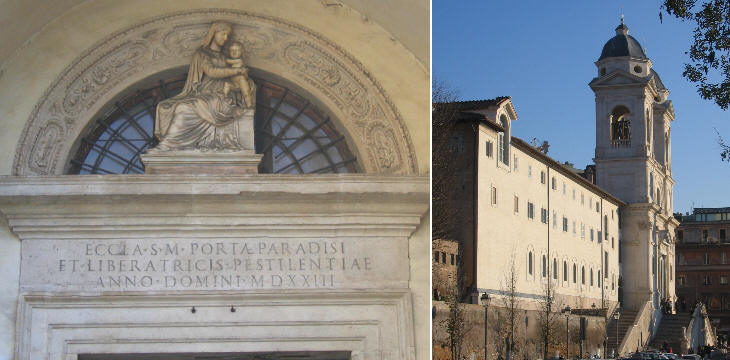
(left) S. Maria in Porta Paradisi; (right) SS. Trinità dei Monti
Pestilences and sexual diseases led the popes to build S. Giacomo degli Incurabili, a new hospital to care for the sick: an inscription above the entrance into S. Maria in Porta Paradisi, the hospital mortuary chapel, recalls the 1523 pestilence, a very severe one.
The conflict between France and Spain was fought also outside the battlefields: the Spanish with S. Pietro in Montorio sul Monte Gianicolo had a church which could be seen from all parts of Rome; the French responded by building on Mount Pincio a church (SS. Trinità dei Monti) and a monastery which had equal visibility: even today a Spanish school is located very near S. Pietro in Montorio and the convent of Trinità dei Monti hosts a very exclusive French school.
The events of the early XVIth century led two Florentine writers to analyze the causes of Italy's inability to form a united nation: Niccolò Macchiavelli (1469-1527) wrote a treatise where he developed a political theory on how a Prince could achieve power and effectively rule: in his view force and prudence are the key elements of statesmanship: he is mainly known for having claimed that "the ends justify the means": Machiavelli however placed a number of restrictions on the evil actions which could be accepted; Francesco Guicciardini (1483-1540) wrote a History of Italy between 1494 and 1532, which is regarded as the first modern history book, due to the use of documents to support the account of events. He saw the best form of government in the Venetian constitution: he also investigated the root causes of the Italian political crisis and found them in a national characteristic, the particulare, by which he meant, not so much the defence of petty interests, but an excess of individualism, not accompanied by an appropriate understanding of its long term consequences.
Pope Adrian VI was the last non-Italian pope for many centuries: he was buried in S. Maria dell'Anima, the church of the German nation: Proh Dolor! Quantum refert in quae tempora vel optimi cuiusque virtus incidat (Oh disgrace! The actions of even the best of men depend on the times he lives in) the inscription on his monument, summarized the unhappy pontificate of this pope.
Papa Clemente VII
Il conclave che portò all'elezione del Cardinal Giulio de' Medici (Papa Clemente VII) durò più di 50 giorni; egli era il candidato di Carlo V, mentre Francesco I favoriva l'elezione del Cardinal Alessandro Farnese: in the end it was Cardinal Pompeo Colonna, the representative of the still powerful Roman family, who decided the election.
Pope Clement VII soon departed from the policy of neutrality which his predecessor had tried to follow and in January 1525, envisaging a final victory of France, he switched side and promised Francis I to help him; it was a very untimely decision, because in February of that same year Francis was defeated at Pavia and taken prisoner: he wrote to his mother ".. all is lost to me save honour and life, which is safe..". He was forced to sign the Treaty of Madrid by which he renounced all his claims in Italy and Flanders.
Maybe to stick to his family's heraldic symbol (a salamander which goes unscathed through fire), after he returned to France, Francis declared he had no intentions of complying with the provisions of the treaty, claiming he had signed it under duress; Pope Clement VII supported Francis' position and the two promoted a league (League of Cognac) against Charles V. In Rome Cardinal Colonna, whose family had many possessions in the Kingdom of Naples which belonged to the emperor, reacted negatively to the pope's decision and with Neapolitan troops he took control of the city and forced the pope to ask for a truce; when the cardinal's troops returned to Naples, the pope deprived him of all his charges and seized some fiefdoms of the Colonna.
Charles V decided to punish the pope for what he saw as treasonous: a composed army made of German, Spanish and Italian mercenaries under the command of Charles of Bourbon, a French nobleman who had split from his king over a matter of heritage partition, invaded the Papal State and moved towards Rome; the Duke of Urbino, who had reasons for not helping the Medici pope, did not intervene as he could have done: in May the Imperial army reached Rome: il 6 maggio 1527 (Sacco di Roma) the Vatican was attacked at Porta S. Spirito: 147 Guardie Svizzere su 189 morirono in the fight to give time to other members of the guard to escort the pope through il Passetto to Castel Sant'Angelo: the clash caused also the death of many students of Collegio Capranica and of many inhabitants of Borgo. Benvenuto Cellini, then a young musician at the papal court, claimed in his autobiography that he shot the bullet which killed Charles di Borbone on the first day of the assault. For one month the pope resisted in the fortress, while the many Lutherans who were part of the German troops made mock processions on Ponte Sant'Angelo calling for Martin Luther to become pope. Having lost their leader the Imperial troops felt free to sack Rome. The situation worsened two days later when Cardinal Colonna brought to Rome another army: contrary to the traditional account which puts the blame only on the landsknechts, the Lutheran mercenaries, all the nationalities of the Imperial army took part in the looting and the killing. The abbot of S. Agostino wrote that the Germans behaved badly, the Italians did worse, but the Spanish were the worst of all. On June 5 the pope surrendered and for seven months was held prisoner in Castel Sant'Angelo; in December, by bribing some officers, he managed to escape in disguise and reach Orvieto. It is estimated that the population of Rome was halved as a result of the Sack of Rome.
The war between Francis and Charles eventually ended in 1529 with a peace which confirmed the provisions of the treaty of Madrid; Pope Clement VII had no other option than to reconcile with Charles V, whom in 1530 he crowned Holy Roman Emperor in S. Petronio, the cathedral of Bologna: the reconciliation was celebrated with the engagement between Margaret, natural daughter of the Emperor and Alessandro de' Medici, whom many historians believe to be the illegitimate son of the pope. Charles helped the Medici to regain control of Florence by sending an Imperial Army to lay siege to the city which resisted for nine months, with Michelangelo in charge of its fortifications.
Pope Clement VII continued to raise the suspicions of Charles V as he gave indications of leaning again towards France: in 1533 the pope travelled to Marseille to celebrate the marriage between Catherine, a distant cousin of the pope whom he regarded as a niece, and Henri, son of the French king who in 1547 became king of France; after the death of her husband in 1559, Catherine was to play a major role during the French Wars of Religion.
The pope, by continuously delaying his approval of the divorce of King Henry VIII from Catherine of Aragon, caused the establishment of an independent Church of England. He did not see the final phase of this development, the November 1534 Supremacy Act which declared Henry supreme head of the Church in England, because he died in September 1534.
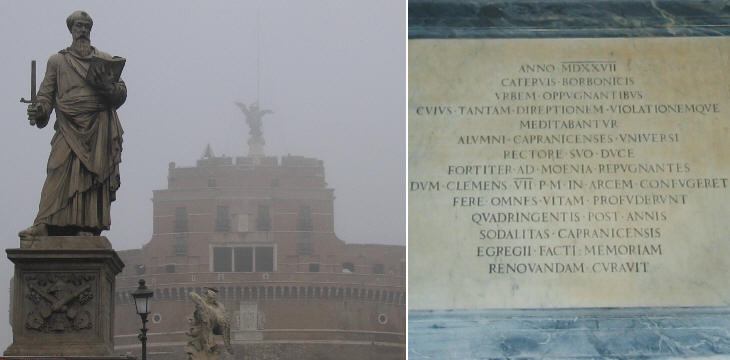
(left) Statue of St Paul at Ponte S. Angelo; (right) Inscription in Collegio Capranica celebrating the sacrifice of its students during the Sack of Rome to protect the flight of Pope Clement VII (DUM CLEMENS VII P.M. IN ARCEM CONFUGERET)
In his last days Pope Clement VII commissioned the Last Judgement to Michelangelo: he had been imprisoned, he had seen Rome sacked, the Church in disarray, his political plans fail: it is not surprising that he felt the need to assert the existence of a divine justice. It is most likely for the same reason that he placed at the beginning of Ponte S. Angelo a statue of St Paul brandishing a sword: in October 1530 a flood (recorded in an inscription in S. Maria sopra Minerva) damaged the bridge and the pope promoted its restoration and the construction of two small chapels on the square leading to it; the choice of the statues of St Peter and St Paul as a proper introduction to the Vatican may seem obvious, but while St Peter is portrayed in a rather conventional manner, St Paul is depicted while he announces the punishment for the sinners. Hic retributio superbis (here the retribution for the haughty), the inscription at the base of the statue, hints to the kind of sinners the pope despised most.
Like his cousin Pope Leo X, Clement VII gave his name to a new street (Via Clementina) which is no longer called after him: it is Via del Babuino which with Via di Ripetta and Via del Corso makes up the Tridente, the three streets converging on Piazza del Popolo. The street facilitated the access to SS. Trinità dei Monti, a French church, so in a way it served a political purpose.
The many calamities which occurred during the pontificate of Pope Clement VII left few resources for new palaces or churches. In 1533 Baldassare Peruzzi started to build a palace for the Massimo family whose residence had been damaged during the Sack of Rome. Other buildings of this period were Palazzo del Banco di S. Spirito which was decorated by a gigantic (lost) coat of arms of the Medici popes; Villa Lanti; S. Silvestro al Quirinale; Palazzo Orsini, built on top of the ruins of Teatro di Marcello.
* The image used as a background for this page shows Adam portrayed by Michelangelo in the ceiling of the Sistine Chapel.
Iconografia
The burning of Girolamo Savonarola by an unknown contemporary painter - Museo di S. Marco - Florence.
The School of Athens fresco by Raphael (1509) in the Papal apartments - Rome.
Ritratto di Francesco Maria Della Rovere di Raffaello (1504) - Galleria degli Uffizi - Firenze.
Ritratto di Francesco Maria Della Rovere di Tiziano (1532) - Galleria degli Uffizi - Firenze.
David di Michelangelo (1501-04) - Galleria dell'Accademia - Firenze
Apollo Belvedere - Musei Vaticani - Roma.
Laocoonte - Musei Vaticani - Roma.
Ceiling of the Sistine Chapel by Michelangelo (1509-12) - Sistine Chapel - Rome.
Ritratto di Papa Giulio II di Raffaello - Galleria degli Uffizi - Florence.
Ritratto di Papa Leone X di Raphael - Galleria degli Uffizi - Florence.
Incendio di Borgo by Raphael (1514) in the Papal apartments - Rome
The Transfiguration by Raphael (1518) - Musei Vaticani - Roma.
Ritratto di Papa Clemente VII by Sebastiano del Piombo (1531) - Museo Nazionale di Capodimonte - Naples.
Last Judgement by Michelangelo (1535-41) - Sistine Chapel - Rome.


