IL PERIODO REPUBBLICANO
In questa pagina:
Una difficile transizione e i primi eroi romani
Espansione della Città
Vecchi siti repubblicani
Crisi e rifondazione
Guerra in mare (Rostra)
Spostamento del porto
Un nuovo giocatore nel Gioco del Mediterraneo
Iconografia
Una Difficile Transizione
e i primi Eroi Romani
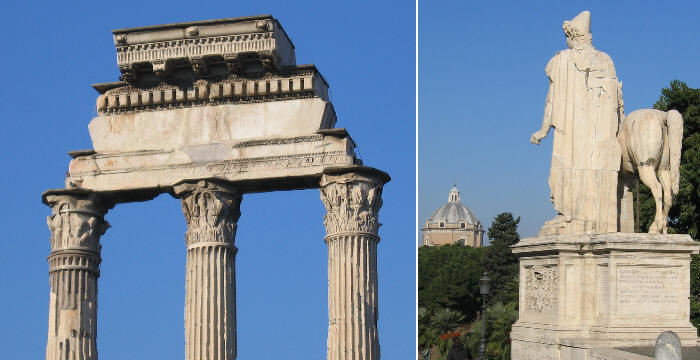
(a sinistra) Particolare del tempio dei Dioscuri Castore
e Polluce nel Foro Romano;
(a destra) statua di uno dei Dioscuri in Piazza del Campidoglio;
sullo sfondo la cupola de il Gesù
Il rapimento di Lucrezia, di William Shakespeare
From the besieged Ardea all in post,
Borne by the trustless wings of false desire,
Lust-breathed Tarquin leaves the Roman host,
And to Collatium bears the lightless fire
Which, in pale embers hid, lurks to aspire
And girdle with embracing flames the waist
Of Collatine's fair love, Lucrece the chaste.
Cherchez la femme (cercate la femmina) è un famoso modo di dire francese per significare
che dietro molti eventi ci sono affari di cuore. Secondo la tradizione, anche dietro
la cacciata di Tarquinio il Superbo, il settimo e ultimo re di Roma,
c'è una faccenda di cuore. Sesto Tarquinio, figlio del re, si invaghì di Lucrezia,
moglie di Tarquinio Collatino: un giorno egli abbandonò il campo romano vicino ad Ardea, la città che il padre stava assediando,
e tornò a Roma. Tentò di introdursi in casa di Lucrezia e, una volta con lei,
cercò di stuprarla. La minacciò con la sua spada: o lei avrebbe acconsentito o lui l'avrebbe uccisa
con una dei suoi schiavi e avrebbe raccontato di averli sorpresi in intimità. Questo è quello che
qualche ora dopo Lucrezia raccontò a suo padre e a suo marito, prima di uccidersi con un pugnale.
La sua famiglia portò il suo corpo nel Foro e lì, un amico di famiglia, Lucio Giunio Bruto,
incitò i Romani alla rivolta contro il re e il suo wicked son.
Quando Tarquinio il Superbo apprese quel che stava succedendo a Roma, precipitosamente vi ritornò,
ma solo per scoprire che le porte di Roma erano chiuse e i Romani sulle mura, pronti a difendere la loro
città.
According to the traditional account, Tarquin the Proud sought help from Porsenna, il re etrusco di
Chiusi (nel sud della Toscana) che mosse con un grosso esercito verso Roma
e piazzò il suo accampamento sul Gianicolo;
quindi cercò di attraversare il fiume al Ponte Sublicio,
ma un soldato romano, Orazio Coclite, riuscì a fermare gli Etruschi sul ponte
mentre i suoi compagni abbattevano il ponte stesso.
Alla fine lui precipitò nel Tevere ma riuscì a salvarsi a nuoto e a raggiunfere Roma.
He was not the only Roman hero of that war: Porsenna had not been able to seize Rome,
but by controlling the right bank of the Tiber he blocked the
supplies which the city received from Ostia; the Romans wondered for how long they could
resist: a young member of a noble Roman family, Gaius Mutius Scaevola , decided to sacrifice his
life to save Rome. Disguised as an Etruscan soldier, he managed to
enter the enemy camp; he then looked for the royal tent as his mission was to kill Porsenna with his dagger.
He found a large and decorated tent and inside it the man he was looking for. In a fraction
of a second he plunged the dagger into the king's heart. The last scream of the victim and the fall of his
dead body alarmed the sentinels, but Mutius Scaevola did not even try to escape, as he thought
that by showing to the Etruscans he did not care about his own life, they would have understood
that the Romans could not be won.
He expected to be immediately put to death, but to his great surprise
he was brought before Porsenna; the Etruscans did not wear
identification badges and Mutius had mistook a high dignitary for the
king. Once he realized he had failed, he told the king that there were
300 other Romans ready to make the attempt again. A furious Porsenna
threatened to send him to the stake; Mutius calmly placed his right
hand on a brazier, as to punish it for its failure, and, without
showing a sign of pain, he kept it there until it was totally burnt.
Porsenna got the message and sought a peace agreement with the Romans.
This (in my view extraordinarily modern) account hides what most likely
happened: the Etruscans had waged war against Rome and had managed to
expel the king and to impose on the Romans a very unfavourable peace
treaty.
Mutius Scaevola
is remembered by a very common Italian sentence mettere la mano sul fuoco
(to put one's hand on the fire), meaning that someone is totally sure that what he says is true.
According to many historians Scaevola means left-handed and that it was added to the
name of the hero after he lost his right hand.
The transition from monarchy to republic is associated also with a pair of twins, the second set(*)
after Romulus and Remus. Tarquin the Proud, in addition to the help of Porsenna sought that of other Latin towns.
The Latin and the Romans clashed at Lago Regillo, a now dried lake, not far from
Ponte di Nona:
the Roman cavalry attacked the enemy and at that point the Romans saw
Castor and Pollux (*)(or Polydeuces), the Dioscuri, sons of Zeus,
galloping at their side. The divine appearance strengthened their
resolution and they defeated the Latins. The Romans worshipped Castor
and Pollux in a temple in the Forum (which was rebuilt several times);
the Dioscuri were also portrayed in two sets of gigantic statues, now
in Piazza del Campidoglio and in Piazza del Quirinale.
Their inclusion among the Roman deities is a sign of the first contacts
with the Greek colonies in southern Italy and in particular with
Tarentum where the two demigods were worshipped. It also shows that the
Roman society had an open and tolerant approach to religious matters.
Espansione della Città
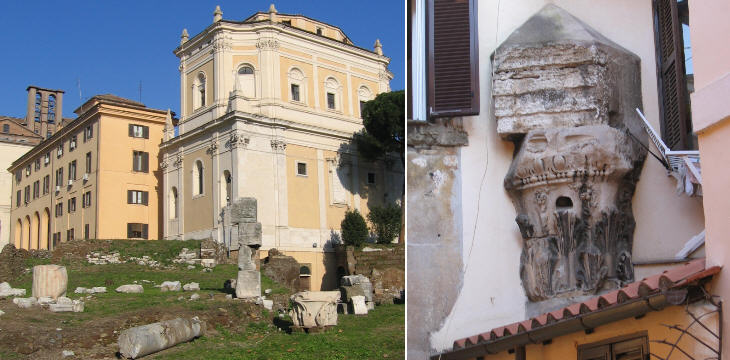
(a sinistra) Rovine del Tempio di Bellona (dietro di esse la Chiesa di S. Rita); (a destra) colonna di un tempio vicino alla vecchia Piazza di Pescheria
At the end of the monarchy Rome consisted of the Palatino and
Campidoglio hills and of the two flat areas next to them, one (the
Forum) to the north of them, the other Velabro, between the hills and
the river. In the first centuries of the republic the city expanded
along the river towards the vast flat land, almost encircled by a bend
of the Tiber, and which later on became known as Campus Martius (the field of Mars), because the Roman army used it as a
training ground.
This part of Rome, broadly corresponding to Rione Sant'Angelo, has been inhabited
without interruptions for more than 2,500 years; in the 1930s excavations near Teatro di Marcello
brought to light some Roman temples which lay under medieval buildings,
but many are still hidden, although they have been identified. They
constitute part of the so-called Roma sotterranea, the underground legacy of Rome.
Ipogea (tombs below the ground) and other underground monuments, in addition to
their archaeological interest, offer the visitor a bit of speleological zest.
Occasionally a hidden piece of ancient Rome requires you to go up the
stairs and not down. In Via Sant'Angelo in Pescheria, behind the old
Piazza di Pescheria (fish market), a still standing column of Tempio di
Giunone Regina is embedded in a small house, but its decorated capital
comes out of the roof. To see it you need to enter the house at No 28,
go up the staircase and look from the window at the upper floor towards
No 11.
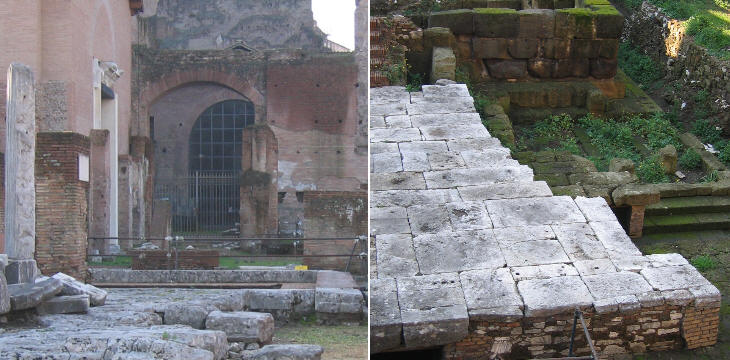
(a sinistra) Fonte di Giuturna vicino S. Maria Antiqua (S. Maria Liberatrice):
(a destra) particolare di vecchi Republicani in Largo di Torre Argentina
Res publica è il nome che i Romani diedero al loro sistema
politico after the expulsion of the last king. The new system was an oligarchic one, with all
the power in the hands of a small group of families, the patricians (patricius
= having noble father). The Senate, the members of which were
patricians, was the most important institution, but the ongoing affairs
were managed by annually appointed magistrates, the praetors (maybe the
word means those who go first, because they led religious or civil
processions). During wars or other emergencies, the Senate had the
option to entrust what we call today the executive power to a single
praetor, who was called dictator. Eventually the number of praetors having jurisdiction in political and
military matters was fixed at two: the consuls. Definitely the history of Rome had a liking
for pairs. At the end of the XVIIIth century the admiration
for the ancient classic world was so high that the French Republic introduced the
consuls in its constitution, but Consul Bonaparte managed to become Emperor Napoleon in
less than a decade, while in Rome
the move from consuls to emperors was a process which required centuries.
Archaeologists have found in the Roman Forum at least eight pavement layers. Those related to the early republican
period are covered by travertine pavements dating from later periods. This is very evident in the excavations in Largo
di Torre Argentina, where one can see the old tufa pavement under a travertine one.
The
Dioscuri, not only had helped the Romans at Lago Regillo, but they also
had immediately reported the good news to Rome. They were seen with
their horses at a spring at the foot of the Palatino, very near the
site where their temple stands: archaeologists have found evidence that
a fountain was built to control the spring in the early republican
period, but its travertine border belongs to a later period.
Crisi e Nuova Fondazione
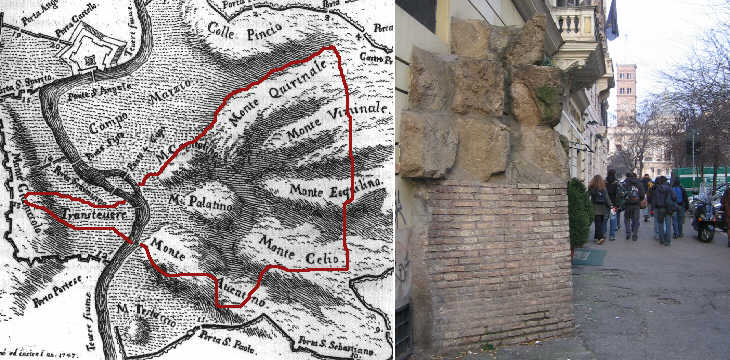
(A sinistra) Map of the so-called Servian walls; (right) a section of the Servian walls found in the XIXth century near Chiesa dei SS. Vito e Modesto
Marco Furio Camillo è considerato da molti storici come il secondo fondatore di Roma. Nel
396 guidò l'esercito Romano contro la ricca città estrusca di Veio (vicina all'odierna Isola Farnese),
situata 10 miglia a nord di Roma. La presa di Veio segnò la fine della minaccia etrusca allo sviluppo di Roma. In pochi anni i Romani
presero Faleria, a town
north of Veii and the security of Rome from Etruscan attacks was further ensured
by the conquest in 389 of Sutri, located in a key position on the road leading to Rome.
The success of Camillus at Veii attracted the envy of other patrician families and he was accused
of having royal ambitions: he chose to go into voluntary exile at Ardea, not far from Anzio.
But Rome had not yet completely enjoyed the benefit of its victories, when a new unexpected
threat came from the north. In 390 (or in 387) a tribe of Gauls, the Senones, invaded the Etruscan territories and moved
southwards under the leadership of Brennus. The Romans placed their legions along the Allia, a
small stream near Monterotondo, to prevent them from reaching Rome; the Gauls simply routed the Roman army. The
soldiers who had managed to escape from the battlefield, fled back to the city in disarray.
The
Romans barricaded themselves in the Campidoglio, where one night they
were alerted to a Gallic attack by the sacred geese of Juno. The rest
of the city was plundered by the Gauls, in what can be seen as an
anticipation of the barbarian invasions which occurred 800 years later.
The event is associated with a couple of famous sentences: Brennus had
agreed to leave Rome if the Romans had paid a certain amount of gold.
At the weighing of the gold, the Romans discovered that the weights
were heavier than standard ones. When they complained he shouted Vae victis (woe to the vanquished): at this point Marcus
Furius Camillus made his unexpected appearance followed by a Roman army and threw his sword into the scale proclaiming: Not auro, sed ferro, recuperanda est patria.
(not gold, but steel redeems the nation). He then attacked the Gauls and forced them out of Rome.
Notwithstanding the happy, albeit miraculous, end of these events, it is said that the
Romans wondered whether they should rebuild their city on the same site or move to a more easily
defensible location; eventually this option was discarded, but the awareness of the
weakness of the old fortifications led to the decision to build a new set of walls to protect the whole city and not just
the two original hills. These walls are called Servian, after Servius Tullius, the sixth
king of Rome, but they belong to the early republican period, although they were
to a great extent rebuilt several times in the following centuries. The main remaining
sections are located near Termini railway station (Aggere Serviano)
and near Chiesa di S. Saba,
but smaller parts of the walls can be found elsewhere
in Rome.
Guerra sul Mare
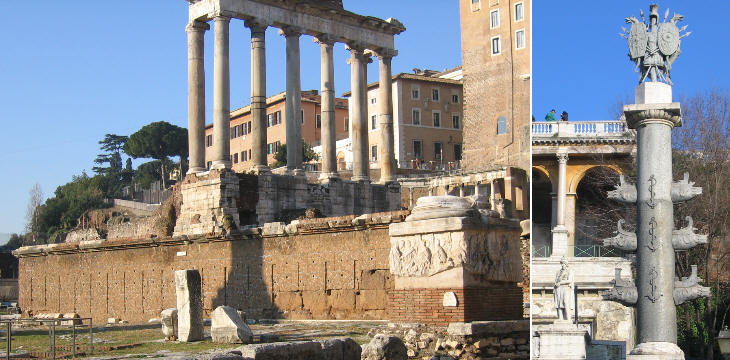
(left) Rostra nel Foro Romano;
(a destra) Colonna rostrata in Piazza del Popolo
While the Etruscans blocked the expansion of the Romans towards the north,
that southwards was also rather difficult due to the hostility of the Volsci, an Italic people
occupying the coastal plain south of Rome: their main towns were Velitrae (Velletri),
Antium (Anzio) and Anxur (Terracina). The wars the Romans waged against them
led to many land battles, but in 338 there was what is recorded as the first Roman naval
battle in the sea near Anzio. In those days the ships travelled along the coastline, so the Roman ones,
en route towards the harbour of Ostia from the south, were at risk of being captured by the Volsci.
The excitement for this first naval victory was such that the captured ships' bronze beaks (rostra)
were placed in the Forum in an open square (Comitium - go together), where all the
Romans could see them.
In 260 the Romans defeated the Carthaginians at sea near Milazzo in Sicily: the rostra
captured in that battle were placed on a column in the Comitium. In 29 Augustus, after having defeated
the Egyptian fleet at Action in Greece, in the frame
of a general restructuring of the Forum, moved the rostra to a sort of large altar
which ended by being used to speak to the Roman people assembled in the Forum. 2,000 years
after its erection the column
with the Carthaginian rostra inspired the Neoclassic decoration of Piazza del Popolo.
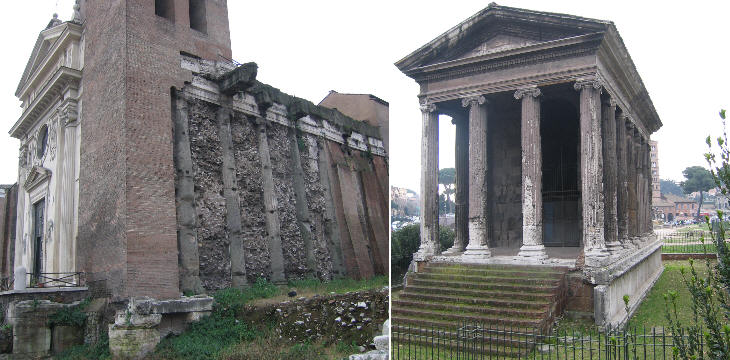
(left) Temple of Foro Olitorio now included in S. Niccolò in Carcere; (right) the high basement of Temple of Portunus
Many believe that behind the expansion of Rome lay a militaristic and expansionistic drive: this is probably due to the fact
that wars, battles, heroes and the likes appeared more interesting to both the writers
and readers of books on the history of Rome: however it is more consistent with the actual
development of the events to make a parallel between the growth of Rome with that of
the British Empire, which was clearly
driven by trade interests.
Rome was a large emporium (trade centre) well before having an imperium (command and later on empire). The republican
walls protected an area which by far exceeded that of Athens, at a time when Rome
did not even rule over the whole of Latium. The decision to found the city on a low hill shows
that military considerations were not high in the mind of Romulus and that he was mainly
interested in the commercial benefits Rome would gain from being placed on the Tiber.
At the beginning ships moored near the Velabro, but in the republican period the area was too congested and gradually
a river harbour was developed in what is today called Testaccio.
The area of Velabro was embellished by the merchants who continued to meet there: they
built many small temples dedicated to the gods who were patrons of their trade (this tradition in a way
was continued many centuries later by the churches built by the medieval
and Renaissance guilds).
Questo spiega perché i templi sono così tanti e così piccoli. Tre templi
erano allineati uno accanto all'altro (li vedete nell'immagine usati come
sfondo per questa pagina); oggi sono quasi interamente
inglobati in una piccola chiesa. I templi del Velabro furono ricostruiti e
riparati più volte, ma conservano qualcosa del loro originale
progetto. Una caratteristica della prima architettura romana è l'altezza
basamento su cui furono costruiti i templi, perché nei primissimi tempi
della loro città i romani semplicemente collocarono un altare su un'altura per consentirne l'accesso
massima visibilità allo svolgimento di cerimonie religiose (principalmente
sacrifici).
Un Nuovo Rivale
nel Mediterraneo

Un tratto della Via Appia nella campagna Romana vicino
al Sepolcro di Gallieno
Con la vittoria sui Volsci Roma non ebbe più rivali nel basso Lazio: controllava un'area
relativamente piccola ma più grande di ognuna della tante città ricche colonie dell'Italia meridionale.
Queste però non costituivano un fronte unito, erano divise come le loro sorelle in Grecia.
Alcune di loro videre in Roma una potenziale alleata nelle loro lotte coi vicini. Roma stabilì
con loro alleanze chiamate foedus and in some cases granted
citizenship rights to their patricians.
Al fine di accelerare le comunicazioni con le altre città il console Appio Claudio (Cieco) promosse
la costruzione della prima strada romana, che da lui prese il nome di via Appia.
Essa inizialemnte si fermava a Terracina, ma con la crescita dell'influenza romana nel Sud Italia
fu più volte prolungata, fino a giungere a Brundisium (Brindisi), la porta della Grecia.
Iconografia
I personaggi e gli eventi raccontati in questa pagina hanno ispirato
tanti artisti: in particolare Lucrezia fu ritratta da diversi pittori rinascimentali:
Cranach, Tiziano, Lotto, Veronese e Rembrandt.
Orazio Coclite e Muzio Scaevola furono entrambi raffigurati nell'affresco del
Palazzo dei Conservatori.


