LA ROMA BIZANTINA
In questa pagina:
Il Regno Ostrogoto
La guerra Greco-Gotica
Nuovi invasori: i
Longobardi
Roma durante il dominio Bizantino
Il crescente ruolo del Papa
La Donazione di Sutri
Iconografia
Il Regno Ostrogoto
In
476 Odoacre fu
nominato Dux Italiae dall'Imperatore Romano d'Oriente, ma presto
entrò in conflitto col suo formale superiore. Dopo aver ripreso la
Sicilia ai Vandali, Odoacre espanse la sua influenza sui territori tra il
Danubio e il Mar Adriatico; questi territori; (Pannonia e Dalmazia)
appartenevano al defunto Impero Romano d'Occidente, ma l'Imperatore
Orientale Zenone guardava ad essi come alla naturale estensione delle sue
province nei Balcani.
Zenone aveva permesso l'insediamento in Pannonia,
l'odierna Ungheria Occidentale, degli Ostrogoti (Goti dell'Est), una
tribù Germanica che era stata cacciata dai suoi territori dagli Unni. Nel 488
nominò Teodorico, re degli Ostrogoti, Patricius Italiae,
invitandolo ad attaccare Odoacre. Teodorico, diversamente dagli altri capi
Germanici, era stato educato a Costantinopoli, dove aveva trascorso la sua
giovinezza come ostaggio; alla corte imperiale aveva ricevuto
un'educazione militare e aveva servito come ufficiale superiore
nell'esercito dell'imperatore.
Gli Ostrogoti attraversarono le Alpi e presto costrinsero
Odoacre a ritirarsi a Ravenna che era protetta da un anello di paludi.
L'assedio di Ravenna durò tre anni. Alla fine Teodorico, promettendo ad
Odoacre la condivisione del potere, lo convinse
ad arrendersi; però mantenne la promessa solo per alcuni giorni dato che, quasi subito,
durante un banchetto, uccise personalmente Odoacre.
Secondo le regole
tradizionali Germaniche, gli Ostrogoti reclamarono per loro un terzo della
terra, ma Teodorico fece in modo di contenere il risentimento degli ex
signori d'Italia lasciando nelle loro mani l'amministrazione dello stato e
aggiungendo al proprio nome quello di Flavio, un chiaro riferimento alla
gloriosa dinastia Romana.
Il
regno di Teodorico (il Grande) può essere riassunto nella formula due
nazioni uno stato: i Goti erano Ariani, mentre gli Italiani seguivano
il credo Niceno, i
Goti si occuparono della difesa militare del paese mentre gli Italiani
mantennero il controllo del commercio e dell'economia, sia i Goti che gli
Italiani mantennero proprie leggi, per esempio quelle quelle che
regolavano le questioni familiari. Nonostante queste difficoltà per
almeno trent'anni Teodorico riuscì a tenere sotto controllo le ostilità
tra le due comunità: questo risultato fu permesso dalla sua politica
estera: egli acquistò una posizione preminente come capo politico e
religioso dei Regni Germanici Ariani dell'Europa Occidentale e riuscì
pertanto a garantire all'Italia un lungo periodo di stabilità e di pace
che permise una certa ripresa economica.
Verso la fine del suo regno
sorsero delle questioni con l'Imperatore Giustino I, che opprimeva gli
Ariani che vivevano nei suoi territori. Teodorico per rappresaglia
perseguitò alcuni membri dell'aristocrazia Romana. Alla sua morte, nel 526,
i rapporti tra Ostrogoti ed Italiani erano peggiorati considerevolmente.
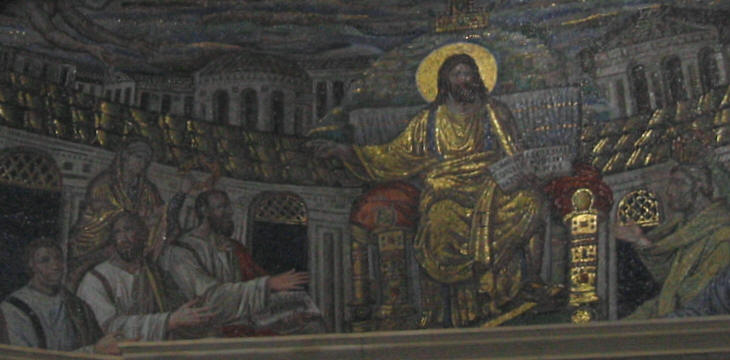
S. Pudenziana: mosaico dell'abside: particolare
Noi spesso pensiamo ai mosaici Cristiani come a una serie di personaggi isolati sopra uno sfondo d'oro o di qualche altro colore uniforme; i primi mosaici di S. Pudenziana (V secolo) mostrano che all'inizio i mosaici Cristiani a Roma continuavano a seguire l'approccio naturalistico dell'arte classica e gli schemi della sua iconografia: Gesù era ritratto come un antico senatore che indossava abiti tradizionali; alla sua sinistra San Paolo era incoronato di alloro allo stesso modo in cui erano incoronati gli imperatori che ritornavano da una campagna vittoriosa; ciascun personaggio aveva una faccia sua caratteristica; sia il ritratto dei personaggi che quello degli edifici rivelavano una qualche legge di prospettiva: sebbene la città sullo sfondo rappresentasse Gerusalemme, essa in realtà mostrava i templi e le basiliche di Roma.
I pochi Goti che vivevano a Roma avevano le loro chiese: S. Agata dei Goti era una di esse: fu dedicata alla santa nel 592 quando l'Arrianorum ecclesia fu convertita da Papa Gregorio Magno, ma il suo nome conserva il riferimento agli antichi proprietari.
La Guerra Greco-Gotica (535-553)
Atalarico, nipote di Teodorico e suo erede, aveva solo dieci anni quando divenne re. Egli morì nel 534 senza definire una chiara linea di successione: i contrasti tra gli Ostrogoti per la successione di Atalarico, attirarono l'attenzione di Giustiniano, l'Imperatore Romano d'Oriente che nel 526 era succeduto allo zio Giustino. Egli ritenne che era giunto il tempo di riunificare l'Impero Romano sotto un solo imperatore e un solo credo.
Nel 533 un generale di iustiniano, Belisario, conquistò Cartagine e il regno dei Vandali in Africa. Da lì Belisario condusse un esercito abbastanza piccolo in Sicilia e, conquistata facilmente l'isola, sbarcò nel Sud Italia. Conquistò Roma nel 536 e tentò di difendere la città dai Goti che in quell'occasione danneggiarono severamente gli acquedotti. Quindi mosse verso nord e alla fine, nel 540, occupò Ravenna. Belisario fu quindi richiamato a Costantinopoli da Giustiniano a causa delle minacce lungo i confini orientali dell'Impero; quando ritornò in Italia nel 544, gli Ostrogoti si erano unito sotto il comando di Totila, che aveva riguadagnato il controllo del Nord Italia e preso Roma. Belisario riprese Roma, ma senza sufficienti truppe e rifornimenti non poté concludere la guerra. Giustiniano sostituì Belisario con Narsete che alla fine, nel 555, riuscì a sconfiggere gli Ostrogoti e a restaurare il dominio imperiale su tutta la penisola.
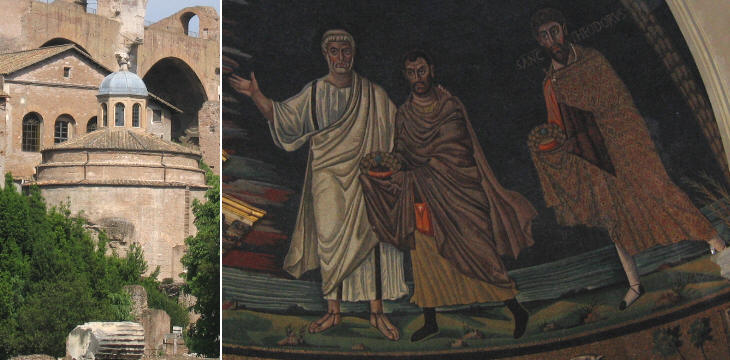
(a sinistra) SS. Cosma e Damiano; (a destra) particolare del mosaico dell'abside che ritrae San Pietro, San Cosma e San Teodoro
Durante il domio degli Ostrogoti alcuni edifici del Foro Romano furono trasformati in chiese: Amalasunta, la figlia di Teodorico, donò al papa una sala del Tempio della Pace e l'annesso circolare Tempio di Romolo: i due edifici furono uniti a formare una chiesa dedicata ai SS. Cosma e Damiano. Papa Felice IV (526-30) fece decorare l'abside con un bel mosaico che mostra lo sviluppo di nuove tendenze. E' interessante osservare che San Pietro fu ritratto come un antico senatore Romano, mentre San Teodoro fu dipinto come un cortigiano imperiale con indosso un elaborato abito di seta che lo ricopre quasi interamente; indossa anche delle calze. La nudità era stata uno dei canoni dell'arte classica; questo mosaico mostra quanto le regole siano cambiate.
La guerra Greco-Gotica ebbe un impatto molto negativo sulla popolazione di Roma: gli effetti della guerra furono amplificati da una pestilenza, conosciuta come il flagello di Giustiniano: scoppiata probabilmente in Egitto, rapidamente si diffuse in tutto l'Impero (il flagello non sparì mai del tutto per almeno due secoli e durante questo periodo ciascuna generazione ne conobbe gli effetti con maggiore o minore virulenza). Roma, come del resto quasi tutte le città italiane, si ritrovò ridotta a poche decine di migliaia di abitanti coi suoi splendidi monumenti imperiali caduti in rovina e ricoperti da una fitta vegetazione. Solo le mura, più volte restaurate, sopravvivevano con le loro dimensioni a ricordare la Roma "Caput Mundi". Grazie alla sua cinta muraria, Roma continuava a rimanere la più grande città d'Europa.
Nuovi Invasori: i Longobardi (568)
L'amministrazione Bizantina non ebbe il tempo di dare impulso alla ripresa economica e al ristabilimento di commerci e comunicazioni che un altro flagello si abbatté sull'Italia.
Nel 568 nuovi invasori attraversarono le Alpi orientali e rapidamente ottennero il controllo del Nord Italia: erano chiamati Longobardi per via delle loro lunghe lance (avrebbero dato il nome alla Lombardia). Come gli Ostrogoti venivano dalla Pannonia (dove Giustiniano aveva concesso loro di stabilirsi) ed erano Ariani. Diversamente dagli Ostrogoti non avevano avuto grossi contatti con la civiltà romana e non avevano abbastanza risorse militari e abilità per completare la conquista dell'Italia. I Bizantini, che potevano contare su di una forte flotta, mantennero il controllo di una fascia costiera sia sull'Adriatico che sul Tirreno.
I Longobardi non avevano una struttura di governo centrale e i loro re avevano solo un potere nominale sui duchi locali (il paese fu diviso in 36 ducati): l'unità d'Italia fu rotta e non sarebbe più stata ripristinata per tredici secoli.
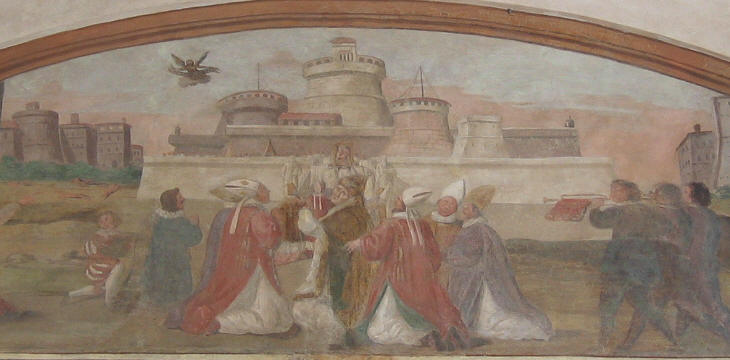
S. Gregorio Magno al Celio: affresco (attribuito al Pomarancio) che ritrae la visione di San Gregorio Magno
I Longobardi non conquistarono mai Roma ma razziarono le sue campagne nel 579 contribuendo al loro impoverimento e al loro finale abbandono. I foschi eventi del VI secolo furono in parte illuminati dall'azione di San Benedetto, il fondatore del monachesimo occidentale, che visse e predicò a Roma S. Benedetto in Piscinula e fondò importanti monasteri a Subiaco. Il suo motto Ora et labora spinse i suoi seguaci a occuparsi di lavori agricoli e, allo stesso tempo, di conservare la conoscenza scientifica dell'antichità.
Nel 590 divenne papa un monaco Benedettino. Gregorio I (San Gregorio Magno) aveva un passato nell'amministrazione civile e aveva trascorso sei anni a Costantinopoli come rappresentante del suo predecessore Pelagio I.
L'inverno del 590 aveva colpito Roma in tre modi: una piena, una carestia e una pestilenza: Papa Gregorio stava guidando una processione a S. Pietro, quando, sopra la fortezza, che un tempo era stata il Mausoleo di Adriano, vide un angelo rinfoderare la spada, segnale che la peste volgeva al termine.
Papa Gregorio intuì che Roma avrebbe potuto ricevere aiuto dall'Esarcato, il governo Bizantino d'Italia che aveva sede a Ravenna, e quasi prese nelle sue mani l'amministrazione di Roma. Nel 593 i Longobardi raggiunsero di nuovo le porte di Roma e, secondo la tradizione, Papa Gregorio si abboccò col re longobardo Agilulfo sui gradini di san Pietro e lo convinse a ritirarsi. Forse Gregorio, che apparteneva ad una famiglia ricca, pagò per far cessare l'assedio.
Con l'aiuto di Teodolinda, moglie di due consecutivi re Longobardi, Gregorio favorì la conversione al Credo Niceno dei membri più importanti dell'aristocrazia Longobarda. Gli storici vedono in questa e altre azioni di Gregorio, come il suo ruolo nella conversione del regno Anglo-Sassone, i primi segnali del ruolo dei papi come Patriarchi dell'Occidente, un titolo che Papa Benedetto XVI ha scelto per concedere tributo alle sensibilità politica.
Roma durante il Dominio Bizantino
The remaining Byzantine possessions in continental Italy were placed under an Exarch, a governor appointed by the Emperor, who resided in Ravenna; Rome was placed under a dux, who reported to the Exarch and who resided in the surviving buildings of the former imperial palace.
The Longobards had established a strong duchy at Spoleto in central Italy, and they easily cut communications between Ravenna and Rome when their relations with the Byzantines were tense (which was the usual situation). The presence and the action of the dux must have had some periods of interruption, during which the popes had to act in his place by taking care of the administration of Rome. Notwithstanding Rome's historical relevance, the ruling Byzantine emperors treated it as a remote province of their empire.
Justinian's dream of restoring the ancient Roman empire was abandoned by his successors who had great difficulties in containing the threats posed by nomadic tribes such as the Avars in the Balkans and by the Sassanids in the Near East.
The final move away from the Roman empire was sanctioned by Emperor Heraclius (610-41) who dropped the Roman title of Augustus in favor of the Greek Basileus (king) and who replaced Latin as the empire's official language with Greek. Heraclius engaged in a long war with the Sassanids who had occupied Syria, Palestine and Egypt and was able to drive them off and eventually he defeated them in 627 in their own territory. But the long war had so much weakened both the Byzantines and the Sassanids that a few years later they were not able to resist the Arabs, who by 642 occupied Mesopotamia and most of Persia, as well as Syria, Palestine and Egypt.
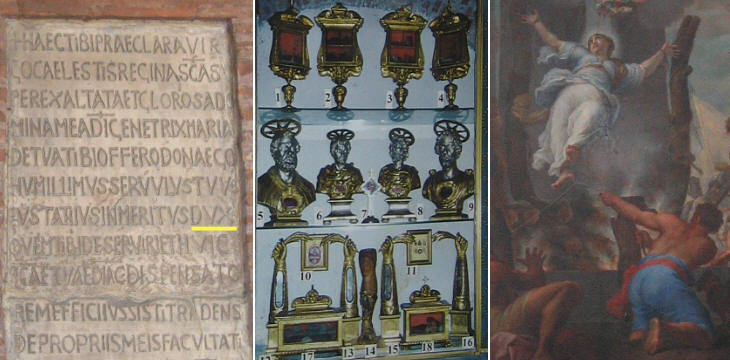
(a sinistra) S. Maria in Cosmedin: inscription celebrating the Byzantine "dux"; (al centro) S. Anastasia: reliquary; (a destra) S. Anastasia: martirio della santa, di M. Cerruti (1722)
During the Byzantine administration because the dux and a certain number of other Byzantine officers resided in the imperial palace, the Roman Forum retained its role of city centre. The various Byzantine emperors were celebrated by changing inscriptions on existing monuments or statues. Colonna di Foca was a column taken from a fallen building and placed on a base to celebrate Emperor Phocas (602-610). The main church used by the Byzantine officers and their families was dedicated to the Virgin - Santa Maria (Antiqua/Liberatrice) - and it was built by enlarging an existing vestibule placed at the beginning of the steps leading to the imperial palace. Nel 625 la Curia Julia, the hall che ospitava le sedute del Senato, fu trasformata in una chiesa dedicata a S. Adriano e un edificio annesso divenne la cappella dedicata a S. Martina.
A ring of churches contoured the western flank of the Palatine: S. Giorgio al Velabro, S. Anastasia e S. Maria in Cosmedin.
While in the eastern provinces of the empire the cult of the saints (at that time mainly martyrs killed during the persecutions) was subject to criticism, in Rome, where so many martyrs had lost their lives, many churches were dedicated to them.
The saints were also celebrated by honouring their relics (on a few occasions their entire bodies, more often fragments of their bones); the reliquary of S. Anastasia has relics of more than twenty saints: they are kept in containers which have the shape of the part of the body from which the fragments were taken.
The cult of the saints had a great importance in favouring the acceptance of the Christian faith in a city which for centuries had had a religion based on a variety of deities, each of whom presided over a sacred location or an activity.
Depending on their background, the martyrs were regarded as patrons of the various craftsmen and some of them, depending on aspects of their martyrdom, were regarded as having a role in fostering the recovery from specific diseases.
In the following centuries the town-states which arose in many parts of Italy placed themselves under the protection of a saint; in their frequent naval battles, the Venetians shouted San Marco, the Genoese replied San Giorgio and then they gladly slaughtered each other.
Ascesa del Ruolo Papale
Al tempo di Giustiniano l'imperatore era de facto head of the Church: the appointment of bishops (and even of the four great patriarchs of Rome, Constantinople, Antiochia and Alexandria) by the local clergy had to be endorsed by the emperor. Justinian himself convened an ecumenical council in Constantinople to condemn new Arian, Nestorian, and Monophysite writings, which he regarded as dangerous for the religious unity of the empire. The pope, as the bishop of Rome was called, was regarded by the emperor as having a supremacy among the patriarchs, but this privilege was easily withdrawn when the pope's views did not meet the emperor's wishes. For this reason some popes were deposed, imprisoned, exiled and even killed by the Byzantine emperors.
The decline of the Byzantine empire and its inability to effectively protect Rome gradually led the popes to take a greater role in the government of Rome, regardless of their religious views and of their country of origin. Egypt had fallen into Arab hands in 642; the Arabs continued their move westwards and in 698 they conquered Carthage, thus cutting trade routes between Rome and northern Africa through which Rome received most of its grain supplies. After having vainly called for Byzantine help, the popes felt they had to find alternative sources of supply and they developed direct "diplomatic" relationships with the Germanic kingdoms of western Europe.
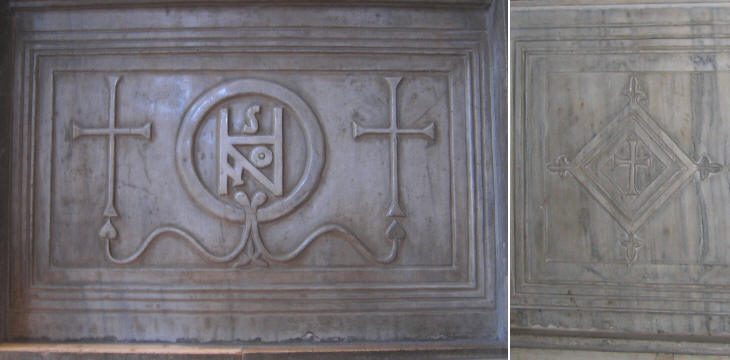
S. Clemente: particolare delle "transennae"
Nel 663 l'Imperatore Costante II visitò Roma per 12 giorni: fu una visita breve ma rapace dato che ordinò di imbarcare per Costantinopoli the bronze tiles del Pantheon (che nel 608 era stato convertito in chiesa); the bronze tiles non raggiunsero mai Costantinopoli perché finirono in mani Arabe. Constans was welcomed by the pope, but he reaffirmed the emperor's role establishing that the pope should report to the Patriarch of Ravenna, as that city was the seat of his exarch.
Works of art had travelled the other way round (from Constantinople to Rome) when Pope John II (533-35) embellished S. Clemente with elegant "transennae" forming a parapet separating the altar from the nave. They came from Constantinople where they were developed as a form of elegant decoration which refrained from all references not only to animal life, but even to the vegetable world: the letters of the pope's name (JOHANNES) were used to decorate some "transennae" in what can be regarded as an anticipation of the Muslim calligraphic art (for another example of "transenna" see a basilica built by Justinian in Ephesus). The image used as a background for this page shows a detail of another "transenna" in S. Clemente.
La Donazione di Sutri (726)
During the VIIth century the Longobards slightly expanded their influence in Italy by conquering Genoa and the Italian Riviera, but they were unable to unify the territories under their rule into a strong kingdom.
At the beginning of the VIIIth century the strong leadership of King Liutprand (712-744) concurrent with a grave religious dispute caused by Emperor Leo III, helped the Longobards in the conquest of Ravenna and of all the Byzantine territories in northern Italy. In 718 Leo III managed to resist an Arab siege of Constantinople and in 726 he faced another Arab invasion of the Byzantine territories: the fight between the Byzantines and the Arabs had clear religious connotations: the invaders claimed that the original Christian monotheism had been turned into a pagan idolatry and cited the worship of images as supporting evidence of their claim. In 727 Leo III thought that he would deprive the Arabs of this argument by prohibiting paintings and statues inside religious buildings (iconoclasm). In Italy Leo's edict was immediately opposed by Pope Gregory II and revolts broke out in Ravenna and other towns in the Byzantine territories. The Longobards, who had abandoned the Arian creed, profited from the unrest and King Liutprand invaded the Byzantine possessions and easily occupied them from Bologna to Ancona, with the sole exception of Ravenna (which eventually capitulated in 737).
Liutprand advanced towards Rome but at Sutri he was met by Pope Gregory II who convinced him to withdraw his troops: in this context the king donated to the pope the town of Sutri and other nearby castles which were eventually called Patrimonium Petri and became the first territory under the formal rule of the pope.
A few years later the donation of Sutri was felt to be an inappropriate basis on which to justify the temporal (related to worldly matters) power of the popes and a forged document (Donation of Constantine) claimed that l'Imperatore Costantino had donated to Pope Sylvester I the city of Rome and the entire Western Roman Empire.
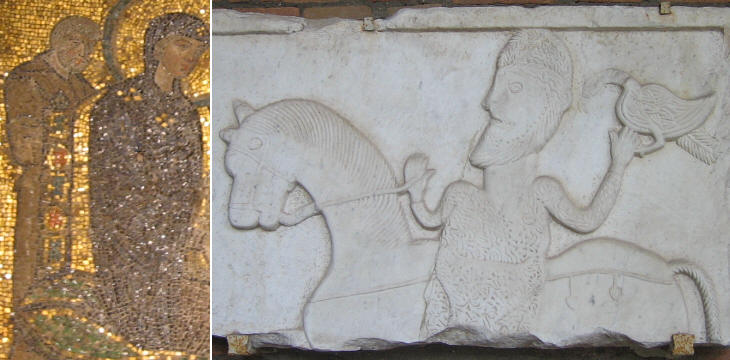
(a sinistra) S. Maria in Cosmedin: particolare di un mosaico dell'VIII secolo; (a destra) S. Saba: VIIIth century relief portraying a falconer
L'invasione Araba della Palestina e della della Syria forced some communities of monks to seek refuge in Rome where they founded the monasteries of S. Saba and SS. Vincenzo e Anastasio alle Tre Fontane, thus increasing the importance of eastern culture in Rome. Between 685 and 752 eight out of ten popes were either of Greek or of Syrian origin.
The worship of images continued to produce fine mosaics: Papa Giovanni VII (705-07) commissioned for S. Pietro a cycle of mosaics of which only one has survived (now in S. Maria in Cosmedin): it shows a skilled knowledge of this technique while a relief (S. Saba), which is attributed approximately to the same period, documents the dramatic loss of expertise in a field where Rome had excelled. The relief is a rare case of a Roman early medieval work of art not portraying a religious subject.
Iconografia
Giustiniano e la sua corte mosaico in S. Vitale - Ravenna.
San Gregorio Magno di Pierre Paul Rubens (1577-1640) in S. Maria in Vallicella.
Theodolinda incorona il suo secondo marito incisione del XIX secolo.
La Donazione di Constantino di Giovanni Francesco Penni (1496 - 1528) in Sala di Costantino - Vatican City.


