SECULUM FERRI
L'importanza crescente del Papato, culminata nell'800 con
l'incoronazione a imperatore di Carlo Magno, riuscì ad ostacolare
la completa decadenza e a imprimere nel tempo una nuova fioritura della
città.
La Roma Cristiana si appropriò anche dei templi dell'area
centrale (il Pantheon venne trasformato in chiesa nel 609 d. C.) e molti
edifici religiosi riutilizzarono i resti di grandi monumenti pubblici
consentendone la conservazione o comunque la continuità del ruolo
urbanistico.
In questa pagina:
Roma tra Longobardi e Franchi
Il Sacro Romano Impero: breve rinascita
Una nuova minaccia: i Saraceni
Saeculum Ferri
Gli Ottoni
Iconografia
Roma tra Longobardi e Franchi
Nel 711 gli Arabi (o Mori, com'era chiamati
usualmente) invasero il Regno Crstiano-Visigoto di Spagna e in appena otto
anni conquistarono quasi tutta la penisola Iberica con l'eccezione di
alcune regioni montuose del nord. Nel 721 attraversarono i Pirenei e si
spostarono nel Sud della Francia: nel 732 pianificarono l'invasione della
Francia ma nella battaglia di Tours (nota anche come battaglia di Poitiers)
furono sconfitti da Carlo, un duca dei Franchi, una tribù germanica che
dominava il nord della Francia, il Belgio, l'Olanda e parte della Germania
Grazie
a questa vittoria, che fermò l'espansione musulmana in Europa, Carlo
divenne noto come Carlo Martello e si guadagnò un potere incondizionato
presso i Franchi, sebbene non fosse il loro re.
Nel 736-37 egli lanciò
una serie di campagne vittoriose contro le roccaforti Arabe nel Sud della
Francia con l'aiuto di Liutprando, re dei Longobardi: in questo modo i
Franchi entrarono sulla scena politica italiana; il papa vide in loro i
difensori della Cristianità e della chiesa Romana dalle ambizioni
Longobarde e Bizantine.
Charles Martel non aveva mai avuto l'interesse
di diventare re, anche quando il trono era rimasto vacante per diversi
anni ma suo figlio Pipino il Giovane (noto anche come Pipino il Breve) che
aveva ereditato dal padre il reale dominio sui regni Franchi decise di
assumere il titolo di Re. Si rivolse a papa Zaccaria per ricevere
l'investitura papale e su questa base fu incoronato nel 752. Non fu un
evento particolarmente significativo della storia di Francia, ma lo fu per
la storia della Chiesa Romana: al suo vescovo e non all'Imperatore
d'Oriente era stato chiesto di assegnare un titolo reale.
I legami tra
i Franchi e il papa divennero più forti quando Pipino dichiarò guerra ai
Longobardi che avevano attentato ai possedimenti papali intorno a Roma:
Pipino costrinse i Longobardi a restituire al Papa - e non all'imperatore
Bizantino - la città di Ravenna e la regione circostante che essi avevano
occupato alcuni anni prima. Era un altro
passo verso il riconoscimento del papa come suprema autorità del mondo
Cristiano, ruolo fino a quel momento attribuito all'imperatore Bizantino.
Il
re Longobardo Desiderio tentò di contenere l'espansione Franca dando in
sposa la figlia a Carlo Magno, figlio di Pipino, ma Carlo Magno non esitò
a ripudiare la moglie e ad invadere l'Italia nel 773 per portare aiuto a
Papa Adriano I. Prima del 776 Charlemagne conquistò l'Italia
settentrionale e fu incoronato Re dei Longobardi.
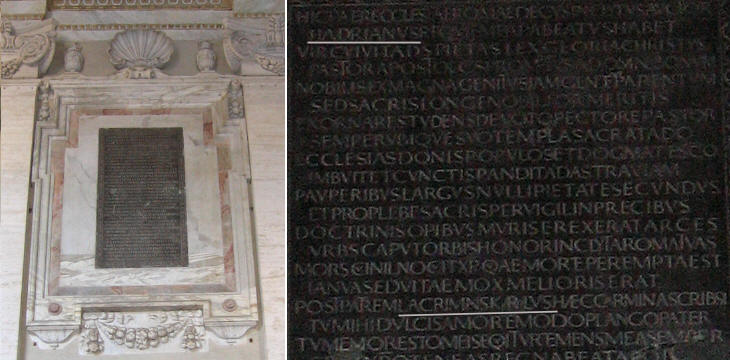
S. Pietro: epitaffio dedicato da Carlo Magno a Papa Adriamo I
Charlemagne e Papa Adriano I svilupparono tra loro una relazione così stretta che alla morte del papa nel 795 fu lo stesso Carlo Magno a dettare l'epitaffio; l'epitaffio fu inciso su di unapietra nera a imitazione delle iscrizioni antiche e fu collocato in S. Pietro. Quando la vecchia basilica fu sostituita dalla nuova, l'iscrizione fu sistemata nel 1618 nel portico costruito dal Maderno per Papa Paolo V. Sfortunatamente fu posizionata così in alto che pochi la notano ed è molto difficile leggerla. Charlemagne guardava al papa come a un padre e scrisse l'epitaffio con le lacrime agli occhi (PATREM LACRIMINIS KARLUS HAEC CARMINA SCRIPSI).
Il Sacro Romano Impero: una Breve Rinascita
Papa Leone III, il successore di Adriano I, fu deposto nel 799 da un gruppo di nobili famiglie romane. Fu confinato in un monastero ma riuscì a fuggire e alla fine raggiunse Carlo Magno in Germania per chiedergli aiuto. Charlemagne scortò il papa fino a Roma nel Novembre dell' 800 e alla fine riuscì a convincere i Romani ad riaccettare Leone come vescovo. In una messa tenuta in S. Pietro Papa Leone incoronò Charlemagne e gli diede il titolo di Imperator Romanorum. Non è sicuro se Charlemagne lo sapesse da prima e fosse d'accordo ad essere nominato imperatore, come pure non è certo se il papa intendesse rifondare l'Impero Romano (il Sacro Romano Impero).
Probabilmente Papa Leone vide in Charlemagne il nuovo imperatore dell'unico impero che conosceva, quello di Costantinopoli: per lui il trono era vacante. Irene, vedova dell'Imperatore Leone III, aveva regnato per anni al posto del figlio Costantino VI, ma era stata estromessa dal potere dal figlio quando quegli era stato nominato imperatore nel 790 all'età di 19 anni. Irene tuttavia aveva tramato contro il figlio e nel 797 Costantino fu fatto prigioniero, gli furono cavati gli occhi e fu lasciato morire per le ferite. Irene, che non aveva altri figli, tornò a regnare da sola ma il papa la considerava un'usurpatrice.
Charlemagne non fece nessun reale tentativo per rivendicare il trono di Costantinopoli (a parte un probabile tentativo di sposare Irene) e alla fine raggiunse un accordo con i successori di Irene sull'uso di un titolo leggermente differente che evitasse attriti fra i due poteri.
Mentre gli effetti immediati dell'incoronazione di Charlemagne furono limitati il loro impatto a lungo termine fu più sostanzioso per la storia di Roma, che tornava dopo secoli ad avere un ruolo politico attraverso gli atti del suo vescovo, la cui nomina non fu più soggetta all'approvazione dell'imperatore Bizantino. Charlemagne fu considerato dalla Chiesa Romana come il nuovo Costantino e la sua statua fronteggia quella dell'antico imperatore nel portico di S. Pietro.

S. Prassede: mosaic in Cappella di S. Zenone: (left to right) Teodora (the pope's mother), S. Prassede, the Virgin Mary and S. Pudenziana
Sotto l'ombrello protettivo di Carlo Magno e per alcuni anni dopo la sua morte, nel 814, Rome enjoyed a period of peace and of economic development. Pope Leo III in order to substantiate the new role of the pope through an appropriate lifestyle improved his Lateran residence by building two banqueting halls one of which named Triclinium (banqueting hall in Latin) was embellished with mosaics portraying Charlemagne and the pope (click here for a detail of these mosaics).
Pope Paschal I (817-24) decorated with mosaics S. Cecilia, S. Maria in Domnica and S. Prassede. In this church the pope built a chapel (dedicated to a rather obscure martyr) where he buried his mother. The whole chapel is decorated with mosaics based on an extremely vivid contrast of colours (the image used as background for this page shows another detail of the chapel mosaics).
Una Nuova Minaccia: i Saraceni
In 732 Charles Martel had stopped the Muslim expansion in continental Europe, but not in the Mediterranean where the Arabs occupied Crete in 826 and then began the conquest of Sicily (still a Byzantine possession). It took them eighty years to complete their conquest because Taormina, the last Byzantine stronghold fell into their hands only in 901, but before achieving their final goal they started to raid the coasts of southern Italy. They were called Saracens, a word most likely meaning easterners, a reference to their point of origin.
In 846 Saracen pirates landed at Ostia and from there moved towards Rome; they were not numerous enough to be able to seize Rome, but they sacked S. Pietro, which was not protected by the city walls.
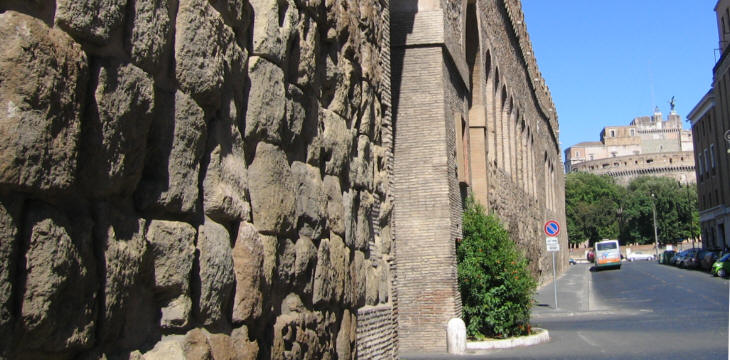
A section of Passetto near Castel Sant'Angelo showing the structure of the walls built by Pope Leo IV
The whole authority of the Pope rested on him being the successor of St Peter and Pope Leo IV swiftly acted so that the tomb of the first bishop of Rome could not be violated a second time. Between 847 and 853 walls were erected to protect the basilica and the various hospices for the pilgrims which existed next to it. It was the first urban development Rome saw after many centuries: it also showed that the pope started to take initiatives which were typical of a sovereign.
(integrare col paragrafo sopra) La fondazione della Città Leonina da parte di Leone
IV (847-55), a seguito del saccheggio compiuto dai Saraceni delle
basiliche di S. Paolo e di S. Pietro, rappresentò un evento molto
importante: cingendo di mura S.
Pietro, il borgo e le "scholae", si venne
a creare una città pontificia esterna al vecchio tracciato delle mura
Aureliane.
The
protection of Rome from the Saracens was pursued also by Pope John VIII
(872-882) who turned the area around S. Paolo fuori le mura
into a fortified burg (Giovannipoli).
Saeculum Ferri
The popes for centuries were appointed with
the formal endorsement of the Byzantine emperors: Pope Leo III had
interrupted that practice which was replaced by a less formal agreement
expressed by Charlemagne and his successors. The popes of the first half
of the IXth century relied very much on the support of the heirs of
Charlemagne. The continuous dynastic quarrels however weakened the power
of the various Carolingian kings among whom the possessions of Charlemagne
had been split. Towards the end of the IXth century and for a long period
afterwards the election of the pope was heavily influenced by Roman
families, who did not hesitate to commit all sorts of crimes to ensure
their candidate was appointed. This period is called Saeculum Ferri or
Obscurum to mean a regression towards a very primitive state.
In
this context two episodes stand out: the legendary appointment of a woman
(Papessa
Giovanni) and the trial of Pope Formosus (891-96), whose corpse was
exhumed by his successor, charged with heresy, sentenced to death,
mutilated and finally thrown in the Tiber.
Pope John X (914-28) managed
to contain the requests of the Roman families and at the same time to form
a coalition with the towns of Naples and Amalfi to eradicate the Saracens
from their permanent settlement south of Terracina. In 915 he
personally took part in the battle which put an end to the threat of a
Saracen invasion, although not to that of sporadic raids. In 928 Pope John
X was deposed, jailed and killed at the instigation of a powerful woman,
Marozia who in 931 managed the election to the pontificate of her own son.
For the next twenty years the popes were puppets in the hands of Marozia
and after her death of her other son Albericus, who obtained for himself
the title of Princeps Romanorum. He was so powerful that in 954,
feeling he was close to death, he forced the Roman clergy to promise that
the new pope would be his son Octavian who became Pope John XII.

Section of the Aventine between (left) S. Alessio and (right) S. Maria del Priorato which was fortified by Albericus
The lack of a strong administration of the city of Rome started a process which in the course of the following centuries led to a partition of the city itself among a number of powerful families. The Palatine, where the Byzantine officers had resided for centuries, lost its importance in favour of the Lateran, the usual residence of the popes.
Albericus had a sort of personal court on the southern corner of the Aventine: he fortified it with walls and towers to protect himself from his enemies in the city.
The Ottonian Emperors
Pope John XII was only 18 at the time of his election and his behaviour was far from meeting the minimal moral requirements of his office, to the point that his opponents called him the new Caligola. In an attempt to expand the Papal State John XII stirred a conflict with the feudal lords of northern Italy and sought the help of Otto, Duke of the Saxons and King of the Germans. In 962 Otto came to Rome and was crowned by Pope John XII emperor of the Holy Roman Empire of the German Nations, a title which lasted until 1806 (see my pages on Vienna, the city of the last Roman emperors). The new emperor signed a document (Privilegium Ottonianum) in which he guaranteed the independence of the Papal State. Relations between the pope and the emperor soon deteriorated and in a matter of months Otto returned to Rome and convened a synod of bishops that deposed John who fled to Corsica from where he managed to incite a revolt against the new pope. Pope John XII returned to Rome where he died three months later: according to the tradition he was thrown out of the window by a jealous husband who had discovered him in bed with his wife.
Otto had no difficulties in imposing the appointment of popes whom he liked; he obtained the power of vetoing a certain candidate from being elected pope, a privilege which he transmitted to his successors.
His son Otto II, who had married a Byzantine princess, maintained a strong control over the actions of the popes, but he died in 983 at the age of 28, leaving a heir (Otto III), just three years old.
In the vacuum of power which followed the death of Otto II, a Roman family, the Crescenzi profited and in 997 rebelled against Pope Gregory V, cousin of the emperor and first German pope. Gregory fled to his cousin who in 998 marched with an army towards Rome. The Crescenzi tried to resist in Castel Sant'Angelo, but in vain; eventually their leader was beheaded and their faction crushed.
Otto set his residence in Rome and probably under the influence of his mother, he adopted elaborate Byzantine court ceremonies. At the death of his cousin he engineered the election of one of his advisers who became pope Sylvester II, a choice of name which established a link with Pope Sylvester I who allegedly had received from Constantine the donazione della città di Roma. Ottone si vedeva come il nuovo Costantino.
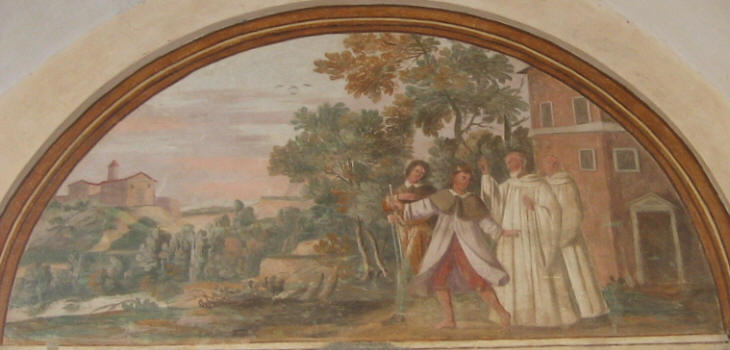
S. Gregorio Magno al Celio: affresco (attributo al Pomarancio) che ritrae S. Romualdo che prescrive una penitenza (andare in pellegrinaggio a piedi fino ad un lontano santuario nel Gargano) a Ottone III
Ottone III e Silvestro II lived in the very last years of the first millennium: the year 1000 was thought to be the end of the world and many tried to purge themselves of their sins. The young emperor who had imposed or tolerated blinding, mutilation and other extreme and cruel punishments sought the advice of leading religious figures. He made several pilgrimages and he built S. Bartolomeo all'Isola. Pope Sylvester II is associated with a gruesome tradition according to which his bones could not rest in peace because he had made an agreement with Evil (read the inscription on his tomb).
Iconografia
L'incoronazione di Charlemagne di Raffaello (1517) nei Palazzi vaticani - Roma.
Il processo a Papa Formoso di Jean Paul Laurens (1870).
L'Impratore Ottone I e papa Giovanni XII affresco del XVII secolo nei Palazzi vaticani - Roma.
L'incoronazione di Ottone III miniatura del X secolo.
Ottone III e San Nilo affresco del Domenichino a Grottaferrata.


