AUGUSTO
In questa pagina:
Antonio e Ottaviano, gli eredi politici di Caesar
Il Secondo Triumvirato: Antonio, Lepido e Ottaviano
La divisione dell'Impero
Guerra Civile (Iseo Campense)
Ottaviano diventa Augustus
Pax Romana
Iconografia
Antonio e Ottaviano
Subito dopo la morte di Cesare
the Senate took control of the events and granted an amnesty to those who had killed him.
At Caesar's funeral however the consul Marcus Antonius (Antony) gained the favour of the
crowd by presenting himself as the political heir of Caesar and by reading Caesar's will
he so inflamed the Romans against those who had killed him, that they were forced to leave
Rome.
Antony
But here is a parchment with a seal of Caesar;
I found it in his closet: 'tis his will:
Let but the commons hear this testament -
Which, pardon me, I do not mean to read -
And they would go and kiss Caesar's wounds
and dip their napkins in his sacred blood,
Yea, beg a hair of him for memory,
And dying mention it within their wills
Bequeathing it as a rich legacy
Unto their issue.
Fourth Citizen
We'll hear the will: read it Mark Antony.
All
The will, the will! we will hear Caesar's will.
William Shakespeare - The Tragedy of Julius Caesar - Act III
Nel suo testamento Cesare aveva nominato un erede, e quello non era Antonio. Cesare si era sposato tre volte e
la sua unica figlia, Giulia, che aveva dato in isposa Pompeo, era morta prima di lui.
Aveva avuto un figlio da Cleopatra, Cesarione, ma questi aveva solo tre anni quando Cesare morì.
L'erede di Cesare era Gaio Ottavio, figlio di Azia, sua nipote, un giovane di
19 anni che era ancora ai primi gradini della scala politico/militare. Era stato adottato da Giulio
Cesare nel 45 e aveva cambiato il suo nome in Gaius Julius Caesar Octavianus (Ottaviano).
Quando Cesare fu ucciso, Ottaviano era in Grecia dove sovrintendeva la preparazione di una campagna contro i Parti.
Tornò rapidamente a Roma per rivendicare la sua eredità, ma Antonio contesto da un
punto di vista giuridico l'adozione da parte di Cesare.
Ottaviano, che poteva contare su una notevole fortuna,
indipendentemente dal retaggio, conquistò il favore delle classi inferiori celebrando i giochi
e distribuzione di denaro: il conflitto con Antonio si concluse con uno scontro aperto. A Modena, presso l'odierna Bologna,
Antonio fu sconfitto da un esercito di sostenitori di Ottaviano.

Foro di Augusto: (a sinistra) uno dei
due ninfei e (a destra) la base dov'era collocata una gigantesca statua di
Augusto, delimitata da due colonne
Ottaviano celebrò Cesare nel tempio maggiore del Foro da lui costruito quarant'anni dopo,
vicino a quello del padre adottivo. Il tempio era dedicato a Marte Ultore,
Marte il Vendicatore (dell'assassinio di Cesare). All'interno del tempio
la statua di Marte fu collocata tra quelle di Venere e di Cesare. Una
gigantesca statua dello stesso Ottaviano (o meglio Augusto com'era allora
chiamato) sorgeva su un basamento a sinistra del tempio: la statua è andata perduta,
ma la base conserva la forma del piede sinistro. Altre statue
raffiguranti membri della gens Julia
(famiglia di Cesare) furono collocate in nicchie ricavate su due muri semicircolari che circondavano piccole fontane.
L'elemento rimasto più impressionante di questo Foro è il muro spesso e alto
dietro il tempio, una sorta di tenda che impediva di vedere ciò che si nascondeva dietro di esso. Questo
era proprio lo scopo del muro, nascondere la visione delle povere abitazioni della
Suburra, un quartiere malfamato dell'Antica Roma.
Il Secondo Triumvirato
Antonio e Ottaviano, nonostante la loro rivalità, furono costretti a raggiungere un accordo
spinti dal comune bisogno di sconfiggere Giunio Bruto e Gaio Longino Cassio, i leader
del complotto contro Cesare; Bruto era stato nominato proconsole dell'Illiria, della Macedonia e dell'Acaia
(Grecia) e Cassio di Siria, costituendo così un ostacolo alle ambizioni di Antonio e Ottaviano.
Un altro elemento che spinse Antonio e Ottaviano a stringere un'alleanza fu il loro interesse
di vanificare i tentativi fatti da molti senatori di
ripristinare l'autorità del Senato.
Nel 43 i due unirono le loro forze con Marco Emilio Lepido,
generale e politico, nominato da Cesare comandante della cavalleria romana. A differenza del
primo triumvirato, il secondo (triumviratus reipublicae constituendae)
non era solo un accordo privato di mutuo sostegno.
Il Senato fu costretto ad approvarlo e ad affidare il governo ai tre triumviri
delle varie province dell'impero.
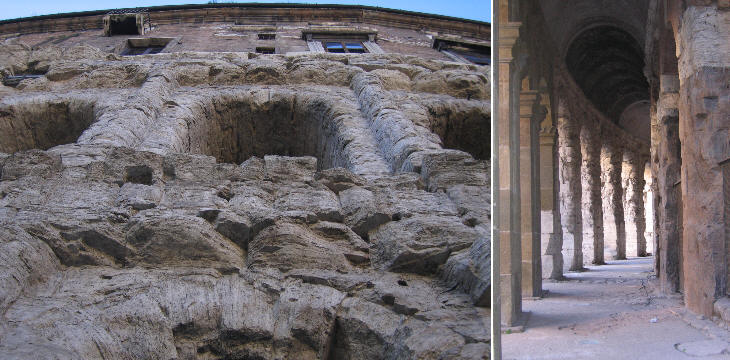
Particolari del Teatro di Marcello
Pompeo aveva costruito un grande teatro e Cesare pensò di costruirne uno anche lui.
Il sito scelto era già sede di un teatro temporaneo in legno. Cesare
non visse abbastanza a lungo
per vedere il completamento dell'edificio che poi fu dedicato da Ottaviano al suo
nipote e genero Marcello, morto all'età di vent'anni.
La struttura dell'edificio è quasi la stessa del Colosseo, con tre
ordini di archi e decorazione di lastre di travertino che ricoprono la spessa struttura muraria.
In alcuni luoghi il travertino è così danneggiato che il suo disegno originale
è quasi completamente perduto e sembra una roccia naturale.
Divisione dell' Impero
Nel 42 Antonio e Ottaviano si spostarono con le loro legioni attraverso il
Mar Adriatico all'odierna Albania; da lì marciarono lungo la Via Egnatia finché
raggiunsero le coste del Mar Egeo. A Filippi, nella Macedonia orientale, trovarono la strada bloccata dagli eserciti
di Bruto e Cassio: le due parti non mostravano un fronte unito: sia Antonio che Ottaviano che
Bruto e Cassio avevano il proprio esercito e agivano in modo indipendente. Quindi ci furono due distinte battaglie di Filippi:
nella prima Antonio riuscì a trovare, dopo vari vani tentativi, un sentiero asciutto nella palude
che proteggeva l'ala sinistra dell'esercito di Cassio. I suoi veterani esperti
raggiunse il centro dell'accampamento nemico; nella confusione che ne seguì alcuni degli alleati di Cassio disertarono e
lo stesso Cassio si suicidò.
Nel frattempo Ottaviano ebbe molto meno successo del suo alleato e Bruto, rinforzato
da parte delle truppe di Cassio, manteneva ancora una posizione forte. Egli sentiva comunque
che il momento non gli era favorevole e pochi giorni dopo decise di ingaggiare lotta con Ottaviano nella speranza di vincere
una battaglia decisiva. Ma con il sito precedentemente detenuto da Cassio ora controllato da
Antonio, si trovò presto in una posizione critica; in poche ore si rese conto che:
"The ghost of Caesar hath appear'd to me
Two several times by night; at Sardis once,
And this last night here in Philippi fields:
I know my hour is come."
William Shakespeare - The Tragedy of Julius Caesar - Act III
e si gettò sulla spada sguainata.
Lepido, il terzo membro del triumvirato, non contribuì alla sconfitta di Bruto
e Cassio e quindi Antonio e Ottaviano ridisegnarono a loro favore la spartizione dell'impero quando nel 40,
dopo un altro periodo di conflitto tra loro, raggiunsero un accordo duraturo e rafforzarono
i loro legami attraverso il matrimonio di Antonio con Ottavia, sorella di Ottaviano.
Ad Antonio furono attribuite tutte le province del Mediterraneo orientale, a Ottaviano, l'Italia, la Gallia
e la Spagna e a Lepido solo la provincia dell'Africa.

(top left corner) Bassorilievo del Tempio di Apollo Sosiano;
(lower left corner) detail
of Portico di Ottavia; (right) a relief near Tempio di Apollo Sosiano
Ottavian dedicò alla sua amata sorella Ottavia, madre di Marcello, un gruppo di edifici
vicino al Teatro di Marcello: due templi erano collocati al centro di un portico rettangolare.
Quello che oggi noi chiamiamo Portico di Ottavia era solo uno dei due monumentali ingressi.
Sempre nella stessa area Octavian relocated an existing temple to Apollo (Sosiano
è un riferimento al console Gaius Sosius, in carica quando i templi furono costruiti).
The details of the design and decoration of these buildings show a high level of
craftsmanship.
Guerra Civile
In 36 Lepidus was forced by Octavian to give up his African province for a nominal
role as Pontifex Maximus in Rome. In practice he was confined in his villa
at Monte Circeo. In the meantime Antony had established his
residence in Alexandria, where in 37 he had married
Queen Cleopatra: he was still married to Octavia, Cleopatra was a widow for the second time as
she had arranged the killing of her second husband.
Antony aimed at establishing an independent kingdom over the eastern Mediterranean
for himself and Cleopatra; he fought against the Parthians and in 34 he conquered Media,
the north-western part of today's Iran.
He celebrated his triumph in Alexandria and during the related ceremonies Caesarion, son
of Caesar and Cleopatra, and the two children Cleopatra had borne to Antony were nominated
kings (you can read Alexandrian Kings, a poem about this event in a page dedicated
to Alexandria).
The underground confrontation between the two remaining triumvirs became an open conflict when
Antony repudiated Octavia. Octavian reacted by denouncing the treason of Antony and he gained
the support of all the western provinces of the empire.
The ensuing war was mainly fought at sea: in 31 at
Azio a
naval battle decided who would have been the sole ruler of the empire; according to the traditional
account at one point Cleopatra abandoned the battlefield. Antony followed Cleopatra
to Alexandria, while his fleet was being destroyed by that of Marcus Vipsanius Agrippa, Octavian's son-in-law. Years later
Octavian celebrated this key victory by founding Nikopolis.
One year later Octavian landed in Egypt and easily seized Alexandria; Antony killed
himself in the traditional Roman way by falling on his sword. Cleopatra, having ascertained
that the apparent clemency of Octavian was only aimed at bringing her alive to Rome to
celebrate his triumph, chose a more elaborate way of escaping her fate. A trusted peasant
brought her an asp (a small viper) hidden in a basket of figs. Her body was not disfigured by wounds
or by swellings.
"...she looks like sleep,
As she would catch another Antony
In her strong toil of grace."
William Shakespeare - Antony and Cleopatra - Act V
Egypt became a Roman province.

(da sinistra a destra) particolari degli obelischi in
Piazza della Minerva e
in Piazza del Pantheon;
the bare breast and the Egyptian robe
of Madama Lucrezia; particolare dell'obelisco
in Piazza di Montecitorio.
"Alexandritis" is the name some old-fashioned citizens
gave to the success met in Rome by everything which came
from Egypt. They regarded it as a dangerous sickness which would eventually undermine
the traditional Roman virtues. The Egyptian fashion replaced in part the Greek one,
although Egypt had been largely Hellenized by three centuries of Greek rule. Ptolomy I, the general who inherited Egypt
from Alexander the Great, promoted the cult of Serapis, a god who combined elements of the
Egyptian god Osiris with those of the Greek mythology.
A gigantic temple to Serapis and his wife Isis (Iseo Campense), was initially built during the second
triumvirate, but it was completed only many years later; destroyed by a fire in 80 AC it was
rebuilt by Domitian.
The alley leading to the temple was flanked not by trees, but by obelisks. Some of its
structures can still be seen inside the buildings of Rione Pigna,
while elements of its decoration are scattered in the area: a cat (more likely a small monkey)
in Palazzo Grazioli, a gigantic foot (Piè di marmo) near Collegio Romano and
part of the
statue of Isis (Madama Lucrezia), che divenne una delle statua parlanti
di Roma, vicino a Palazzetto Venezia.
Due degli obelischi sono tuttora nelle vicine Piazza della Minerva e
Piazza del Pantheon; four other obelisks have travelled a bit: two are still in Rome
in Villa Celimontana
and near the former Villa Peretti,
while of the other two uno è a Firenze e l'altro a Urbino.
In Egypt the Romans found a much advanced astronomical knowledge; while Caesar had made use of it
to reform the calendar, Octavian summoned to Rome Egyptian experts to help in
the layout of a gigantic sundial for which an ancient Egyptian
obelisk was brought to Rome.
Octavian becomes Augustus
Il 13 agosto dell'anno 29 Ottaviano celebrò il trionfo relativo alla conquista dell'Egitto: a memory
of that day survives in the Italian holiday of Ferragosto
(Feriae Augusti), now celebrated on the 15th and "covered" by a Christian holiday.
The Romans were tired of internal conflicts and Octavian was given large authorities to ensure
a period of stability; Octavian however, having seen how his adoptive father had lost
support by his almost monarchical behaviour, in 27 gave up most of the powers he had received
and he formally restored the traditional institutions of the Republic.
The first act of the Senate was to nominate him Augustus, a honorific title meaning
consecrated and most likely derived from the original religion of the early Romans. This was based
on the interpretation of the flight of birds (vedi l'esempio di Romolo e Remos):
the priests were called aruspices (avis=uccello, spicio=guardo) and their response augurium;
no important decision was made without the related augurium (hence to inaugurate).
So augustus was a title having a religious, rather than a military (imperator) or
political (king) meaning; Octavian chose to be referred to as Augustus, because
he thought this title
would have made his almost absolute power better accepted, both in Rome and in the remotest
provinces of the
empire.
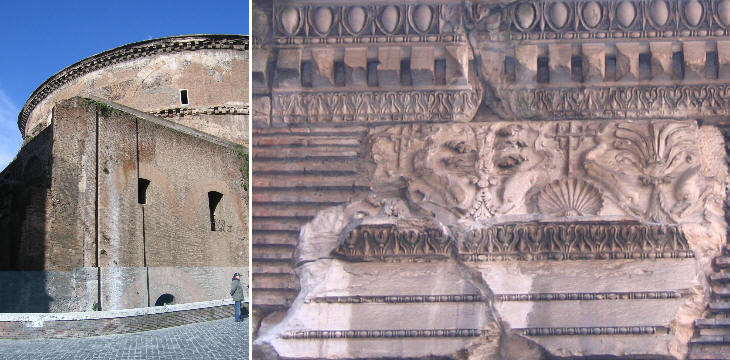
Remaining walls and entablature of Basilica di Nettuno
Marco Vipsanio Agrippa non assistette suo suocero in guerra ma anche in pace;
his name is associated with several adjoining buildings: his name appears on
the inscription of the
Pantheon (which was entirely rebuilt by Hadrian after a fire) and
certainly appeared also in the nearby Terme di Agrippa, the first large baths
built in Rome with the purpose of providing a location for recreation and social meetings.
He took care also of the erection of a large basilica between these two buildings:
Basilica di Nettuno was not a temple, but a large hall for indoor
meetings with a decoration of marine symbols. Its northern wall is located south of the
Pantheon and it retains fragments of a very elaborate entablature.
Because this part of Campo Marzio was often marshy, Agrippa
drained it by digging a small open air canal which brought the excess of water to the Tiber:
the canal was called Euripo, with a reference to the
very narrow channel in Greece
by the same name. Traces of Euripo can be seen in the underground rooms of
Palazzo della Cancelleria.
Pax Romana
Diversamente da Cesare che correva da una parte all'altra dell'impero per guidare personalmente
le sue legioni contro i nemici esterni o interni, Augusto raramente lo fece.
His stepsons Tiberius and Drusus led several campaigns in Central Europe to consolidate the northern border
of the empire. Tiberius in particular conquered all the territories to the right of the river
Danube (today's Bavaria, Austria and western Hungary and a strip along the river in Bulgaria).
Drusus expanded the Roman influence beyond the Rhine, mainly along the coast of the North Sea.
The eastern border of the empire was secured by a peace treaty with the Parthians, who returned
the Roman insignia they had seized at Carre.
A dramatic setback for the Romans occurred in 9 AC when three legions
under the command of Publius Quinctilius Varus were massacred
in the Teutoburg Forest by a coalition of German tribes led by Arminius
(Hermann or Armin). He was a young prince who, while pretending to be a
loyal ally, organized an uprising which caught the Romans when they
were crossing a terrain (a thick and muddy forest), where they could
not fight in the way they were accustomed to. The newly acquired
province of Germania was
abandoned and the Romans gave up their expansion plans beyond the Rhine.
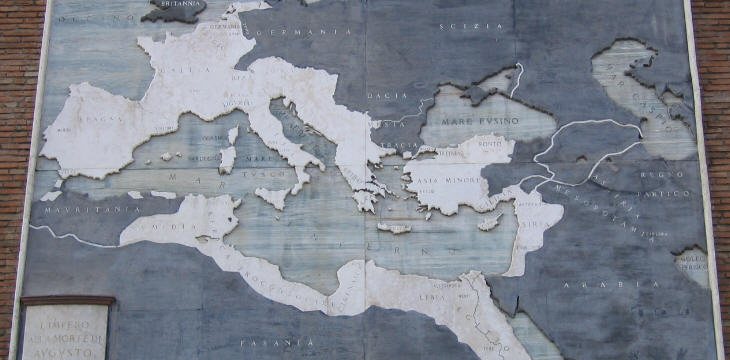
Mappa moderna dell'Impero Romano alla morte di Augusto sul muro posteriore della
Basilica di Massenzio
Nel 13 a.C. Augusto, allora in età di 75 anni, preparò la successione;
he confirmed the appointment
of his stepson and adoptive son Julius Caesar Tiberius as his political heir; he summarized
all he had done for the greatness of Rome in Index Rerum Gestarum, a spiritual
testament which was affixed to the entrance of his Mausoleum
and sent to all the provinces of the empire
(the most complete text is in Ankara).
In this summary Augustus includeva l'Ara Pacis Augustae,
un altar consecrated to him and to the periods of peace achieved during his rule.
Il 14 Agosto Augusto morì a Nola, vicino a Napoli. See Afrodisia, a town which flourished during the reign of Augustus.
Iconografia
The following external links show works of art portraying characters and events
mentioned in this page:
Brutus and Caesar's ghost by William Blake (1806).
Statue of Augustus found at Prima Porta.
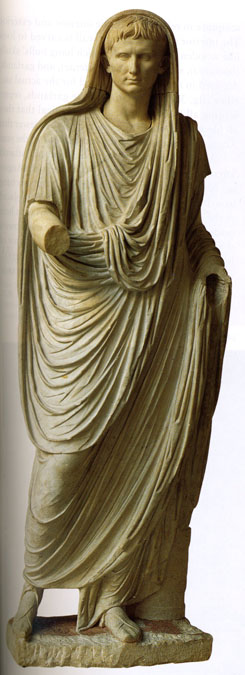
Augustus as Pontifex Maximus.
Head of Cleopatra by Michelangelo.
Cleopatra with the asp by Guido Reni (1575-1642).
Cleopatra with the asp (2) by Guido Reni.
Cleopatra with the asp by Guercino (1591-1666).
The battle of Actium by Lorenzo A. Castro (1672).
Cleopatra's arrival and Cleopatra's banquet by Giambattista Tiepolo (1696-1770).
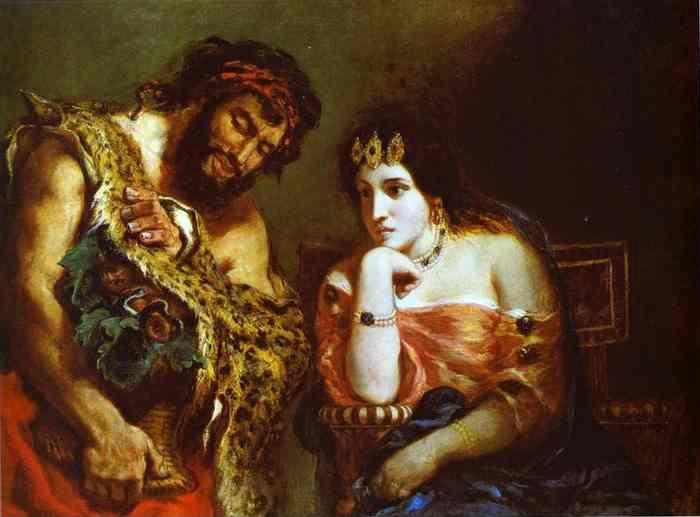
Cleopatra and the Peasant by Eugene Delacroix (1798-1863). If the link does not work
try here.
Antony and Cleopatra by Lawrence Alma-Tadema (1883).
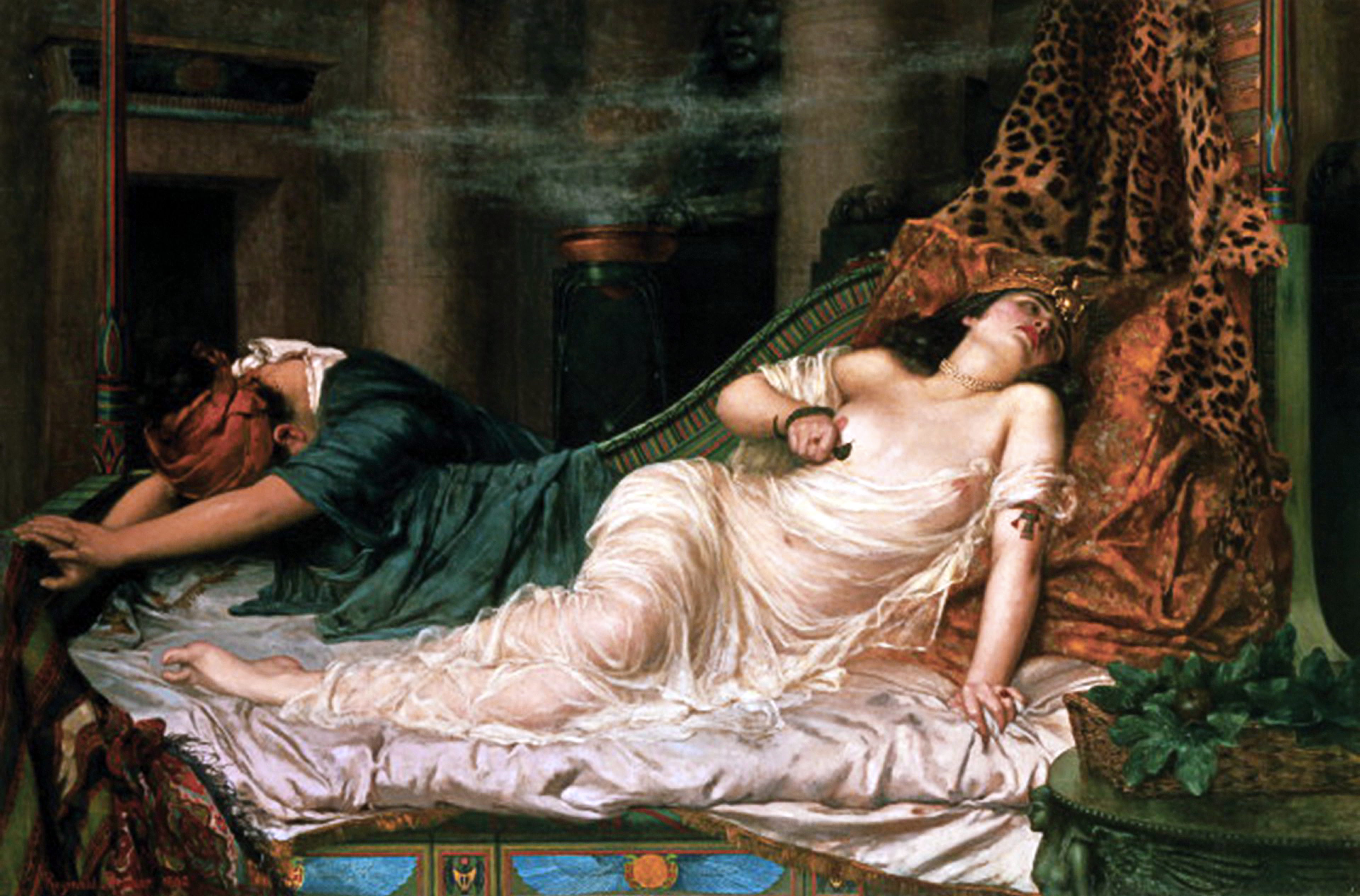
Cleopatra with the asp by Reginald Arthur (1892).
Constantin Cavafis scrisse diverse poesie che fanno riferimento agli eventi di
questa pagina:
IN ALEXANDRIA, 31 B.C.
El venditor 'l é rivà dal so paeset
vizin a' periferia. 'L é ancora inpolverà dal viajo.
“Goma! Incenso! Ojo squisito! Corajo!
É rivà i profumi de majo pa'i cavéi!”
Cussì el ziga par strada. Ma chi lo sinte
inte'l tumulto dee musiche, dee parate, de 'a zent?
“Cossa éa sta follia?” el domanda, inte chel labirinto
de zent, rintronà, urtà, spintonà.
E uno manda in giro 'a busìa enorme, el finto anuncio
del paeazz che in Grecia Antonio 'l à vinto.
Traduzione di Carlo Dariol.
|