CRONOLOGIA DEGLI EVENTI TRA IL 1871 E IL 1911
| Anno | Avvenimenti politici | Eventi a Roma |
| 1870 | Il 20 settembre le truppe italiane
entrano in Roma attraverso la breccia di porta Pia.
I papi si "chiudono" in Vaticano |
Gli interventi urbanistici per adeguare Roma a capitale del regno rivelano subito un pregiudizio contro la città medievale e barocca e la voglia di imprimere uno stile diverso Il primo intervento viene effettuato sull'Esquilino dove si apre, intorno al nuovo quartiere residenziale, Piazza Vittorio, di netta impronta piemontese. |
| 1871 | (Febbraio) Il Parlamento Italiano approva lo
spostamento della capitale da Firenze a Roma. (Maggio) Il Parlamento approva la Legge delle Guarentigie con la quale è assicurata al papa un'entrata annua, la proprietà di un certo numero di basiliche e di palazzi e il diritto a tenere una guardia personale. Papa Pio IX rifiuta la concessione. |
(July) La Corte, il Senato e la Camera dei Deputati si trasferiscono a Roma
e stabiliscono la loro residenza rispettivamente al Palazzo del Quirinale, Palazzo Madama e a
Palazzo
di Montecitorio. Un censimento indica che la popolazione di Roma ammonta 244.844 abitanti. |
| 1872 | Morte di Giuseppe Mazzini, uno dei fautori dell’Unità Italiana. | The Town Council approves a plan for the development of Rome. |
| 1873 | Una legge riduce di molto il numero delle congregazioni religiose: le loro proprietà sono confiscate e trasformate in scuole, uffici governativi e caserme. | La Stazione Centrale Ferroviaria (Stazione Termini) is completed on the site of Villa Peretti. |
| 1874 | Papa Pio IX proibisce ai Cattolici di prendere parte alla vita politica italiana. | Giuseppe Garibaldi è tra i senatori eletti a Roma. Si attiva per promuovere una legge che protegga la città dalle bizze del Tevere. |
| 1876 | La Destra storica perde le elezioni generali. Governava l'Italia dalla morte di Camillo Cavour nel 1861. | Una legge finanzia la costruzione dei murazzi lungo il Tevere.
Viene completata e consacrata St Paul's within the walls, la prima chiesa non Cattolica. |
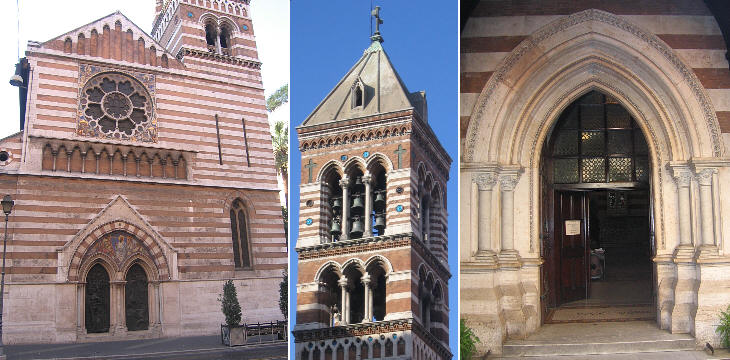
Vista di San Paolo dentro le Mura (1872-76).
| La prima chiesa non Cattolica di Roma è opera di
George Edmund Street, a leading English architect who is best known
for having designed the Royal Courts of Justice on The Strand in
London. Although most of his works were inspired by the medieval
Gothic architecture prevailing in England and France, in the design
of St. Paul's he followed the pattern of northern Italy
churches. The construction of the church was promoted by the Americans in Rome who belonged to the Anglican Episcopal Church (you may wish to visit their web site). The church was built along Via Nazionale, a street the Italian government regarded as the symbol of Terza Roma (the Rome of Italy after those of the Empire and of the Popes). A funny aspect of this decision was that it greatly enriched Xavier de Merode, a Belgian prelate who had been for many years Pope Pius IX's Minister of War. During the last years of the Papal State he bought most of the land between Piazza di Termini and S. Vitale, the site of the future Via Nazionale. |
| Anno | Eventi politici | Eventi a Rome |
| 1877 | Viene introdotta l’istruzione elementare obbligatoria. | Viene completato il Ministero delle Finanze, il più grande edificio governativo di Roma. |
| 1878 | (Gennaio) Morte del Re Vittorio Emanuele II; gli succede il figlio Umberto
I. (Febbraio) Morte di Papa Pio IX; viene eletto papa il Cardinal Gioacchino Pecci (Papa Leone XIII). |
Il Parlamento Italiano approva la costruzione di un monumento a R Vittorio Emanuele II. |
| 1882 | (May) Italy adheres to the German-Austrian Dual
Alliance, as a reaction to the 1881 French occupation of Tunisia,
che gli Italiani vedevano come una potenziale colonia. (Giugno) Morte di Giuseppe Garibaldi. |
Viene abolita la Corsa dei Barberi, a horse race associated with the Roman Carnival. |
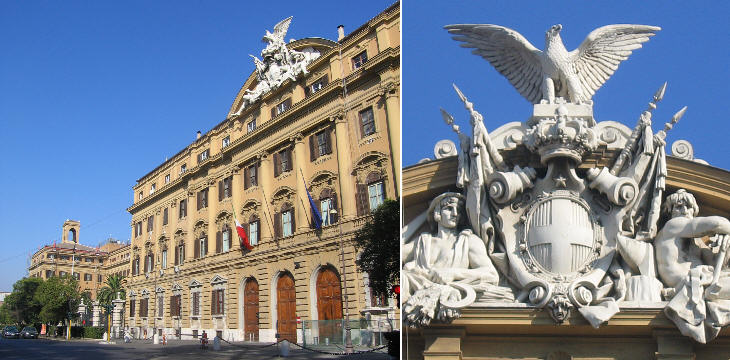
Il Ministero delle Finanze (1872-77) col suo gigantesco stemma.
| Strada Pia, la strada che collega Palazzo del Quirinale with Porta Pia was
sparsely populated before 1870; for this reason it was selected as
the location for many government buildings. It was renamed Via XX
Settembre (the day Italian troops entered Rome in 1870). Ministero
delle Finanze (1872-77) was the largest of these palaces and it was
decorated with a gigantic coat of arms of the Savoia, the Italian
royal family. The style of building and of many others is commonly
called stile umbertino after the name of the king during
whose reign (1878-1900) most of them were completed. It is a
Neo-Renaissance style: the architects who designed them had in mind
not so much the palaces of the Roman Late Renaissance, but two
palaces of the XVIIIth century (Palazzo della Consulta and Palazzo Braschi)
which marked a return to a more composed design after the Baroque
period.
I palazzi in stile umbertino raramente si fanno notare, but they at least spared the historic centre of Rome the extravagant designs which characterized the late XIXth century architecture in many European cities. In the new quarters built outside the walls architects felt freer to experiment: you may wish to see Villino Ximenes. |
| Anno | Avvenimenti politici | Eventi a Roma |
| 1883 | Con il piano regolatore del 1883, si operano grandi sventramenti nell'area centrale, per consentire l'apertura di corso Vittorio Emanuele che congiunge Piazza Venezia con il Vaticano, tagliando fuori l'antica via papale del Corso. Vengono aperti altri tracciati viari come viale Trastevere e via Arenula, e si costruiscono i muraglioni del lungotevere (le ultime inondazioni rovinose erano state quelle del 1870 e del 1900). | |
| 1883 | The competition of American cereals and Chinese/Japanese rice and silk causes a fall of the price of many Italian farming commodities and the start of a massive migration: in the decade 1881-1890 1,700,000 Italians leave the country mainly towards France, Argentina, USA and Brazil. | Viene inaugurato il Palazzo delle Esposizioni. Una compagnia Anglo-Italiana sostituisce i lampioni a gas con lampioni elettrici. |
| 1885 | Truppe italiane occupano il porto di Massaua sul Mar Rosso, primo passo in establishing la colonia di Eritrea. | (1885-1911) Viene posta la prima pietra del colossale quanto inopportuno monumento a Vittorio Emanuele II (vedi qui nella sezione Vasi), che, posto a ridosso del colle capitolino, dovrebbe rappresentare il simbolo della nuova funzione della città: in realtà, nasconde solo il colle e viene nel corso del tempo da varie parti molto criticato. |
| 1887 | Una piccola colonna di truppe Italiane cade in un'imboscata a Dogali per mano degli Etiopi. | Un monumento ai caduti di Dogali viene eretto di fronte alla Stazione Termini: it is made up of an ancient obelisk trovato nel 1882. |
| 1888 | Commercial war between Italy and France: the government favorisce lindustria manifatturiera nazionale alzando i dazi. | Le elezioni municipali sono vinte da una coalizione anticlericale che spiana la strada all’erezione del Monumento a Giordano Bruno. |
| 1889 | Filippo Turati fonfa la Lega Socialista Milanese, una delle prime associazioni socialiste in Italia. | Viene posta la prima pietra di Palazzo di Giustizia (il "Palazzaccio") nel quartiere Prati. Sarà completato nel 1910 e diventerà uno dei simboli del potere burocratico. |
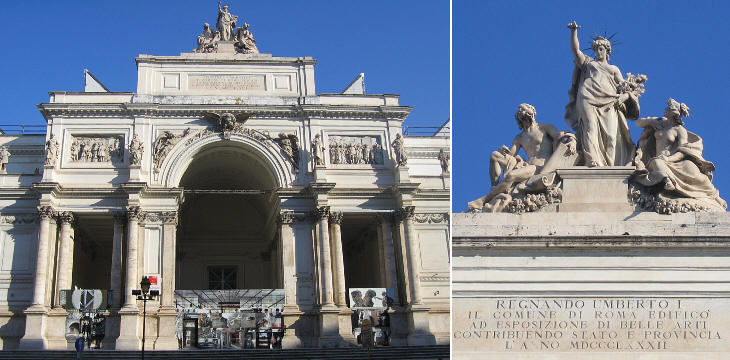
Viene inaugurato nel 1893 il Palazzo delle Esposizioni di Pio Piacentini.
| La maggior parte degli edifici della fine del XIX
secolo servirono a scopi pratici ma alcuni ebbero l'obiettivo
specifico di mostrare che il Governo Italiano era determinato a
perseguire l'abbellimento di Roma.
Notwithstanding the amount of public money poured into some of these enterprises, especially the Monument to King Victor Emmanuel II, the results were seldom satisfactory. La facciata del Palazzo delle Esposizioni fu pensato come un gigantesco arco trionfale, but the size of its upper part and of its statues were not consistent with the lower one and the inscription was trivial. |
| Anno | Avvenimenti politici | Eventi a Roma |
| 1891 | Papa Leone XIII emana la Rerum Novarum, enciclica che si occupa della condizione delle classi lavoratrici. | A modern slaughterhouse is inaugurated at Testaccio, a quarter developed to house the growing working class population of Rome. |
| 1893 | La Banca Romana è coinvolta in uno scandalo per aver stampato moneta senza autorizzazione e per aver finanziato le campagne di politici prominenti. | The Roman real estate boom comes to an end. Several anarchist terrorist acts. |
| 1895 | Le truppe italiane occupano il Tigrai, una provincia tra Eritrea e Ethiopia. | Un monumento celebra Giuseppe Garibaldi, Camillo Cavour e il 20 settembre 1870. Viene completata la Galleria Sciarra Colonna. |
| 1896 | Gli Italiani sono sconfitti dalle truppe Etiopi ad Adua: this event blocks the Italian colonial expansion in the region. | First public screening of movies in Italy at the Roman studio of photographer Henri Le Lieure. |
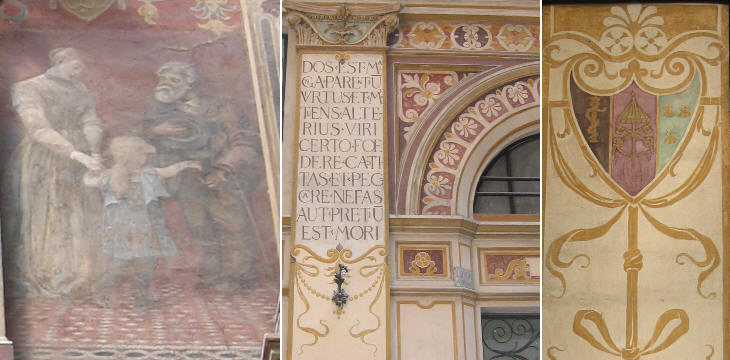
Galleria Sciarra Colonna: particolari della decorazione.
| L'aristocrazia Romana durante il governo papale aveva sempre preferito investire
in proprietà immobili e fondiarie piuttosto che in fabbriche o manifatture.
Per questa ragione le famiglie di nobiltà nera (la nobiltà papalina)
guadagnarono parecchio dal fatto che Roma fosse diventata capitale d’Italia. I Colonna,
i Boncompagni-Ludovisi, i Borghese, i Barberini, i Pamphilj, gli Odescalchi,
i Torlonia avevano tutti grandi possedimenti a Roma
e nelle campagne circostanti, il cui valore crebbe enormemente.
Il Principe Maffeo Sciarra Colonna possedeva i terreni dietro il palazzo di famiglia in Via del Corso and he personally took care of its development. He thought that its central location was appropriate for a shopping arcade (in Italian: galleria). He spared no expense for its decoration which was commissioned to the painter Giuseppe Cellini. Every inch of the arcade was painted; large frescoes portrayed scenes of family life having a moral intent, long Latin inscriptions celebrated the virtues of motherhood; here and there coats of arms of the family (Colonna/Barberini) and initials of Maffeo Sciarra completed the decoration. The venture however did not turn profitable; in addition other initiatives of the prince went wrong so that he had to sell first the works of art of his collection and eventually not only the arcade, but even his family palace. |
| Anno | Avvenimenti politici | Eventi a Roma |
| 1899 | Very tense social situation: the Prime Minister is Luigi Pelloux, a former general who promotes a policy of social repression. | S.T.E.F.E.R, a society for the development of electric tramways and railways is founded with the intent to provide Rome with a modern transportation system. |
| 1900 | King Umberto I is assassinated by an anarchist who claimed vengeance for the workers killed by the army. The new king is Victor Emmanuel III. | Pope Leo XIII proclaims 1900 a Jubilee Year, an indication of less tense relations with the Kingdom of Italy (1850 and 1875 Jubilee Years were not celebrated due to the political situation). |
| 1901 | The king appoints a Prime Minister (Giuseppe Zanardelli) who promotes a policy of social reconciliation. | According to the census the population of Rome reaches 462,783. Villa Borghese is acquired by the State. |

Piazza Cavour: (left) Monument to Camillo Cavour (1895) by Stefano Galletti; (centre) Teatro Adriano (1898) by Paolo Rinaldi; (right) Chiesa Valdese (of the Waldenses) (1911-14) by Guido Bonci and Emanuele Rutelli.
| Piazza Cavour in Prati, similarly to Via Nazionale,
was regarded as a symbol of the Italian Kingdom and of its lay
religious policy. Camillo Cavour was the bête noire of the
Catholic Church, the most disliked Italian politician, for having
supported legislation which abolished clerical privileges. Of the
four Fathers of the Italian Nation (King Victor Emmanuel II, Camillo
Cavour, Giuseppe Garibaldi and Giuseppe Mazzini) the latter had to
wait until 1949 to be celebrated by a monument. A large church of the Waldense community added to the antipapal character of Piazza Cavour. The Waldenses are followers of Peter Waldo, a XIIth century French merchant who gave up his possessions and became a wandering preacher. They were persecuted for centuries and survived only in some upper valleys of Piedmont until they were granted full religious and civil rights by King Charles Albert in 1848. The construction of the church was financed by the widow of John Stewart Kennedy, a rich American banker and philanthropist, born near Glasgow, Scotland. The construction of walls along the Tiber led to pulling down Teatro Apollo (or Tordinona), the best known theatre of Rome. Piazza Cavour was selected for replacing it with Teatro Adriano (the name is a reference to nearby Mole Adriana). It could seat 5,000: it rarely had a full house, so in 1950 it was split into two separate halls. |
| Anno | Avvenimenti politici | Eventi a Roma |
| 1903 | Giovanni Giolitti is appointed Prime Minister: he
rules the country for almost ten years (1903-05) (1906-09)
(1911-14). Pope Leo XIII dies and is succeeded by Pope Pius X. |
The Municipality of Rome founds ICP, an institution for providing houses at low rent: they were first built at Testaccio and S. Saba. |
| 1904 | Giolitti vince le elezioni. Papa Pio X permette ai cattolici di partecipare alla politica. | Viene inaugurata la nuova Sinagoga ebraica. |
| 1907 | Banco di Roma begins a market penetration in the Ottoman province of Tripolitania (in today's Libya) | Maria Montessori opens her first school and daycare centre for working class children in Rome. |
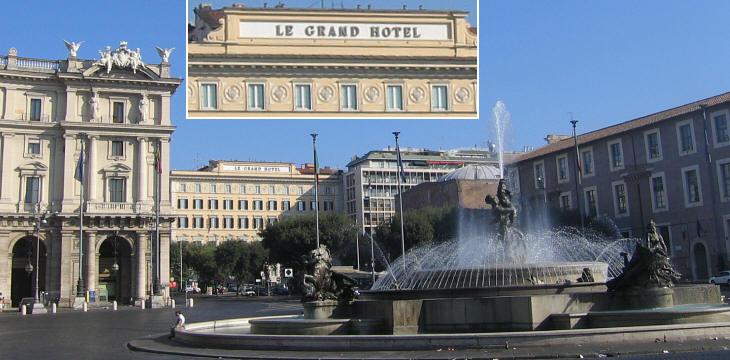
Piazza dell'Esedra (ex Piazza di Termini): in
primo piano la Fontana delle Najadi (1888-1912), sullo sfondo Le
Grand Hotel (1894).
| Piazza del Popolo
for centuries was the first piazza which travellers saw upon their
arrival in Rome. With the development of railway and the location of
Stazione Termini on the site of former Villa Peretti things changed.
The Italian Government promoted the embellishment of a piazza near
the railway station: it was named after the ruins of a circular hall
(exedra) of Diocletian's baths. Piazza dell'Esedra with the high central jet of its fountain and its elegant cafès and hotels was until the 1950s a "must see" for all visitors. Later on private motoring and mass air travel deprived it of its role of first (fine) thing seen in Rome; the closeness to the railway station became a negative factor by attracting not very ideal crowds. In recent years action was taken to bring back Piazza dell'Esedra to its former rank. |
| Anno | Avvenimenti politici | Eventi a Roma |
| 1909 | After the 1908 Austrian decision to formally annex Bosnia-Herzegovina, the major European powers start discussing their respective objectives in case of partition of the Ottoman Empire: Italy seeks endorsement for occupying Tripolitania. | The Roman Town Council, led by Ernesto Nathan, the first mayor not linked to the great Roman families, endorses a new town plan. |
| 1910 | Associazione Nazionale Italiana, a political movement calling for a more active political and military role for Italy is founded in Florence. | The gas factory which was located at Circo Massimo is moved outside the walls. |
| 1911 | (Jan-Jun) The 50th anniversary of the Kingdom of
Italy is celebrated throughout Italy. (Sep) Italy declares war on Turkey and invades Tripolitania. |
Solemn inaugurations of Palazzo di Giustizia, Monument to Victor Emmanuel II, Galleria Nazionale d'Arte Moderna and Ponte Vittorio Emanuele II. |
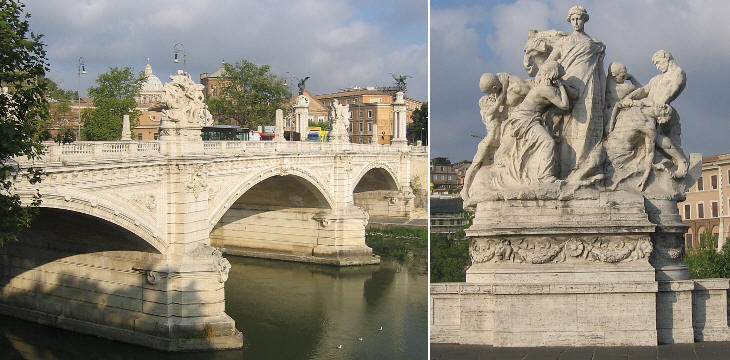
(a sinistra) Ponte Vittorio Emanuele II
(1908-11) progettato da Ennio De Rossi; (a destra) Monarchy gives consolation
to the people of Rome during the 1870 flood (gruppo di statue di Cesare
Reduzzi ed Edoardo Rubino).
| Il confronto con ciò che avevano costruito gli
Imperatori romani e i papi fece venire il mal di testa a politici,
architetti e artisti chiamati a fare di Roma la capitale di uno
stato moderno. Bernini had decorated Ponte S. Angelo with statues and the members of the commission in charge of approving the project for Ponte Vittorio Emanuele II thought that because this bridge was very close to the old one it had to be decorated with statues too. But while the purpose of the angels by Bernini is immediately understood, the subjects of the four groups of statues of the new bridge require a lengthy explanation. In addition, while Bernini played with the wings of the angels to ensure his statues could be seen from various points, the groups of Ponte Vittorio are too big and too parallel to the bridge; passers-by can only see the statues on the other side of the bridge and only from a frontal viewpoint: the end result is that nobody looks at them. |