CRONOLOGIA DEGLI EVENTI TRA IL 1912 E IL 1956
| Anno | Avvenimenti politici | Eventi a Roma |
| 1912 | (Maggio) Le truppe italiane occupano Rodi.
(Ottobre) Peace with Turkey: Italy obtains Tripolitania, Cyrenaica and Fezzan (the three colonies were renamed "Libya" in 1934). |
General warehouses are built in the area between Porta S. Paolo and S. Paolo fuori le Mura. |
| 1914 | (Giugno) Archduke Franz Ferdinand of Austria is
assassinated at Sarajevo.
(Luglio) Austria declares war on Serbia, thus triggering World War I. (Aug.) Italy declares her neutrality, arguing that her alliance with Austria and Germany was of a defensive nature. |
Rallies and strikes (settimana rossa - red week) against the war. |
| 1915 | Nationalists and other groups call for joining the
war on the side of France and Great Britain to complete the
unification of the country by conquering the Italian speaking
provinces of Trentino, Istria and Dalmatia. On May 24 Italy declares war on Austria. |
In May poet Gabriele D'Annunzio leads a series of rallies in Rome calling for a declaration of war on Austria. |
| 1917 | The Russian Revolution allows Germany and Austria to withdraw troops from the eastern front and to launch a major offensive on the southern one. Their armies break the Italian lines at Caporetto (today's Kobarid in Slovenia), but their advance towards Venice is checked at the Piave River. From that time linea del Piave has become an Italian way of indicating a not negotiable position and Caporetto means a terrible defeat. | Passeggiata Archeologica, a large alley around Terme di Caracalla is inaugurated. |
| 1918 | Italian troops cross the Piave River and manage to split in two the enemy's army. Austria calls for an armistice which comes into effect on November 4. | On November 15 General Armando Diaz, Commander in Chief of the Italian Army, is given a triumphal welcome in Rome. |
| 1920 | A long period of social unrest reaches its peak with the occupation of many factories by workers on strike. The fear of a soviet-type revolution helps the growth of right wing movements including the Fascist Party founded by Benito Mussolini, a former member of the Socialist Party. | The first department store of Rome gets a new name: la Rinascente. The first stone is laid of la Garbatella, a new quarter for the working class. |
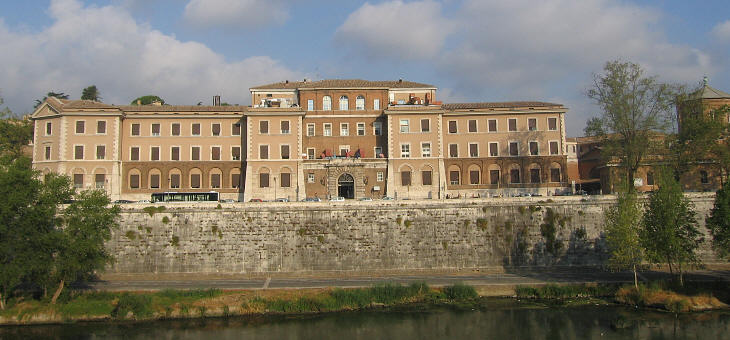
Nuova facciata dello Spedale di S. Spirito in
Sassia sul Lungotevere (1920-33) progettato da Gaspare and Luigi
Lenzi.
| The war effort strained the Treasury and public
works associated with the redesign of the river banks were
postponed. A project to provide Spedale di S. Spirito with a front
along the Lungotevere was not approved until 1920: the simple design
of the new building windows departed from the traditional pre-war stile
umbertino. Not everybody however was badly affected by the war: this tragedy (Italy had 650,000 casualties) brought great gains to those in northern Italy who were involved in providing supplies to the army and to those in Rome who were in charge of the related procurement process. Quartiere Coppedè with its extravagant decoration was designed having in mind this class of nouveau riche. |
| Anno | Avvenimenti politici | Eventi a Roma |
| 1921 | (Jan.) A split among the Socialists leads to the
foundation of the Italian Communist Party. (May) General Elections: Blocco Nazionale, a right wing alliance which includes the Fascist Party falls short of gaining an outright majority. |
A Milite Ignoto (Unknown Soldier) is buried at Monument to Victor Emmanuel II (which from that time is also known as Monumento al Milite Ignoto or Altare della Patria). |
| 1922 | Violent clashes between members of opposite parties. In October Fascist supporters gather in Naples and on October 28 they start marching towards Rome (Marcia su Roma). Prime Minister Luigi Facta is let down by the King when he asks to use the army to stop the march. A coalition government is formed by Mussolini. Pope Pius XI forces the leaders of Partito Popolare Italiano, a Catholic party, to support the new cabinet. | (Oct. 31) Great rally of 100,000 fascists through the streets of Rome (for that time it was a large number: today many more come to Rome to voice their views). In the next Anno a decree stating that April 21 (Foundation of Rome) is a public holiday starts the glorification process of Ancient Rome which will characterize the Fascist period. |
| 1924 | (Apr.) General elections held in a climate of
intimidation give 60% of the votes to a coalition led by the
Fascists. (Jun.) Giacomo Matteotti, a member of the Socialist Party is assassinated. Opposition parties claim the moral responsibility of Mussolini and abandon the Parliament. |
An electric railway links Rome with the beach of Lido di Ostia. |
| 1925 | Several laws increase the power of the police, replace the elected mayors with officers appointed by the government, curtail free press and strengthen the authority of the Prime Minister. Mussolini is called Duce (leader) from the Latin word Dux (after which also duke and doge). | The monument to the fallen at Dogali which stood opposite Stazione Termini is moved to a less prominent location. This because it was a reminder of an Italian military defeat. |
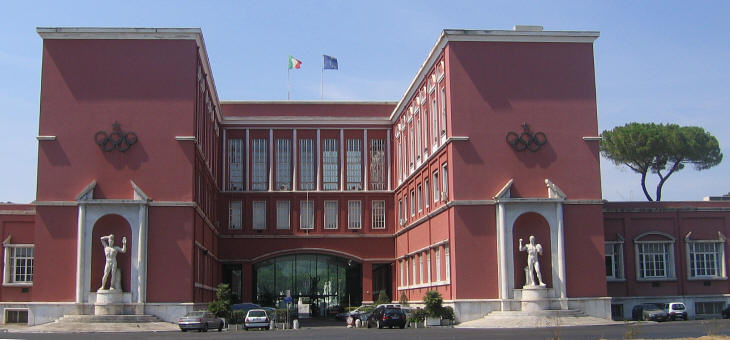
Palazzo dell'Accademia di Educazione Fisica (today Palazzo del C.O.N.I.) by Enrico Del Debbio (1928-32).
| Mussolini had a talent for understanding what his
countrymen liked (or at least a majority of them). Although he was
supported by many conservatives he often managed to appear as an
innovator. Italian (and European) pre-war society was very
conventional, socially blocked and almost dull: one of the causes of
WWI was the dissatisfaction among the younger generations with the
peaceful world in which they had been raised. Mussolini responded to the request for a "heroic" side of life by promoting campaigns which involved the masses. One of them was about fitness: a true Fascist man was not expected to have a prominent belly. Over the Annos gymnastics became a social obligation rather than a personal choice. This effort was supported by the construction of facilities and in Rome was summarized by the buildings of Foro Italico and by its gigantic statues of athletes (one of which is shown in the image used as background for this page). New designs were selected to emphasize the novelty aspect of these facilities and young architects were given the opportunity to carry out their new ideas. |
| Anno | Political Developments | Eventi a Roma |
| 1926 | A failed attempt on his life helps Mussolini in gaining the King's endorsement of a law which dissolves all the opposition parties. A Tribunal for the Defence of the Nation is given special powers. Viene introdotta l'Era Fascista (backdated to October 28, 1922) is introduced. | Work begins at Teatro di Marcello to free the Roman monument and the nearby area from later additions. |
|
11 febbraio 1929 - E' risolta definitivamente
la "questione romana" fra la Chiesa e lo Stato italiano, con il
Trattato Lateranense. Gli accordi furono
stipulati per regolamentare le relazioni tra lo Stato italiano e la Santa Sede
e porre così fine alla questione romana, che si era aperta nel 1870 con
l'annessione dello Stato Pontificio al nuovo Regno d'Italia. Nel 1871, con la
legge delle guarentigie, il governo italiano aveva riconosciuto a papa Pio IX e
ai suoi successori il possesso dei palazzi del Vaticano e del Laterano e il
diritto a una rendita annua di 3.250.000 lire come indennizzo per le perdite
territoriali subite; il pontefice aveva però respinto ogni ipotesi di accordo,
ritirandosi (imitato dai suoi successori) nella piccola enclave di Città
del Vaticano, all'interno di Roma. I negoziati per la composizione dell'annosa questione si aprirono nel 1926 e si conclusero nel 1929 con la solenne firma apposta ai Patti lateranensi dal re d'Italia Vittorio Emanuele III, dal capo del governo Benito Mussolini e (per il papa Pio XI) dal cardinale Pietro Gasparri, segretario di stato pontificio. Gli accordi, che abrogarono la legge delle guarentigie, comprendevano un trattato politico e un concordato. Con il primo veniva ufficialmente creato lo stato indipendente della Città del Vaticano, sotto la piena sovranità della Santa Sede; il papa si impegnava a mantenersi neutrale nelle questioni internazionali e ad astenersi dalla mediazione nel caso di conflitti se non specificamente richiesto da tutte le parti in causa. Il concordato riconosceva il cattolicesimo religione di stato in Italia, definiva una nuova disciplina del matrimonio e dell'insegnamento della religione, mentre un'intesa di natura finanziaria accordava alla Santa Sede un compenso monetario di 750 milioni di lire in contanti e un miliardo in consolidato come risarcimento della perdita del potere temporale avvenuta nel 1870. |
| 1929 | Vengono firmati i Patti Lateranensi nel Palazzo
del Laterano tra Mussolini e il Cardinal Gasparri. It settles
the "Roman
Question". At a ceremony held few days later Pope Pius XI definisce Mussolini as "l'uomo che la Provvidenza ci ha fatto incontrare". |
Mussolini relocates his office to Palazzo
Venezia. The archaeological area of Torre Argentina and a Fire Station at Testaccio are inaugurated. Both public and private buildings start showing inscriptions with the new dating system, usually in the form of Roman numbers followed by E. F. (example ANNO X E.F. = 1932). |
| 1931 | A new Penal Code reintroduces death penalty in time of peace. | According to the censimento the population of Rome reaches 1,008,083. |
| 1933 | Adolf Hitler is appointed Chancellor of Germany and in the next Anno he becomes also the Head of the State (Führer und Reichskanzler). | Mario De Renzi and Adalberto Libera design a "rationalist" Post Office at Via Marmorata. |
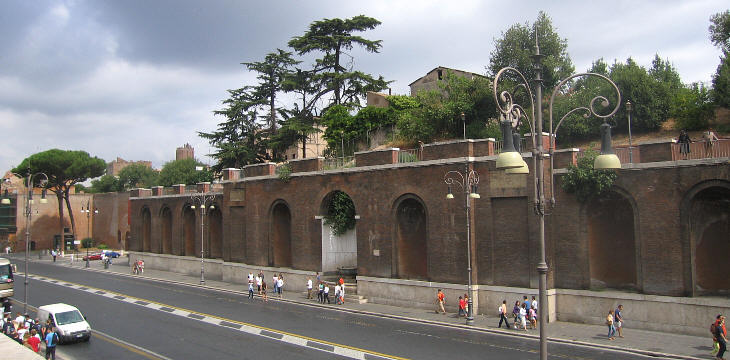
Via dei Fori Imperiali: walls
designed by Antonio Munoz (1931-33).
| Nel ventennio fascista la città subisce una forte espansione e notevoli modifiche nel
proprio tessuto urbano: accanto alla costruzione di nuovi quartieri come
l'EUR, in vista della fiera del 1942, della città universitaria e del
foro Italico, il regime, per esigenze propagandistiche, che rivelano scarsa
sensibilità nei confronti della città medievale, opera numerosi sventramenti
(termine moderno per indicare le demolizioni della Roma storica
durante il Fascismo) per
aprire la via dell'Impero, il corso Rinascimento, via della Conciliazione, via
del Mare, Piazza Augusto Imperatore. La popolazione residente nei vecchi
quartieri deve "emigrare" nelle borgate, avamposti di una nuova città e della
speculazione fondiaria che segnerà il destino di Roma nel secondo
dopoguerra.
The Campidoglio hill
was completely isolated from the rest of the city and a large road
was opened pulling down a medieval quarter between Palazzo Venezia and
Colosseo. It was
named Via dei Monti (the rione it crossed)
and later on Via dell'Impero. According to the original plan a
gigantic Palazzo del Littorio* should have been built
opposite Basilica
di Massenzio, but alla fine Mussolini cambiò idea. |
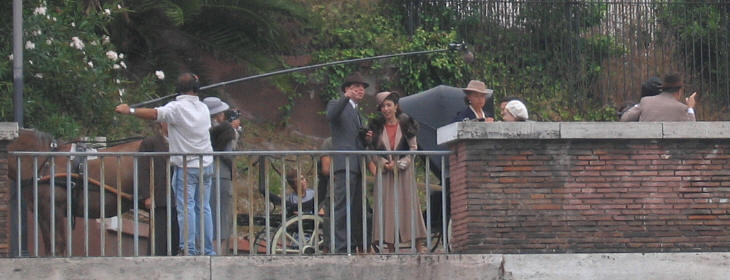
Terrace of Via dei Fori Imperiali (former Via dei Monti): shooting of a TV fiction set in the 1930s.
| Anno | Political Developments | Events in Rome |
| 1935 | (Oct.) Italy declares war on Ethiopia. (Nov.) The League of Nations condemns the Italian invasion and decrees trade sanctions which will prove ineffective. |
Città Universitaria, a large university campus is inaugurated: it retains the name of La Sapienza, the historical university of Rome. |
| 1936 | (May) At the news of the fall of Addis Ababa, the
Ethiopian capital, King Victor Emmanuel III is proclaimed Emperor of
Ethiopia. (Jul.) Start of the Spanish Civil War. Italy supports the rebellion of General Franco. |
The demolition of Spina di Borgo begins. A World's Fair (E.U.R. - Esposizione Universale Romana). is announced for the Anno 1942. |
| 1938 | (Mar.) German annexation of Austria. (Sep.) Laws discriminating Italians of Jewish religion are introduced. |
Inauguration of Corso Rinascimento, a new street
near Palazzo
Madama; the demolition of the area around Mausoleo di
Augusto is completed. Hitler visits Rome: he is entertained with events showing the Italian military might, but at Piazza di Siena he watches a saltarello danced by 800 couples. |
| 1939 | (Mar.) Germany occupies Czechoslovakia. (Apr.) Italy occupies Albania. (Sep.) Germany invades Poland: France and Great Britain declare war on Germany. Mussolini postpones siding with Germany and declares that Italy is "non belligerent". |
The newly elected Pope (Pius XII) reintroduces the possessio, a procession to S. Giovanni in Laterano by which the new Bishop of Rome takes charge of his office. |
| 1940 | (May) German invasion of Belgium and
France. (Jun.) Italy declares war on France and Great Britain. (Oct.) Italy declares war on Greece. |
Inauguration of a monument to Scanderbeg, an Albanian national hero (Scanderbeg means Alexander the Great). |
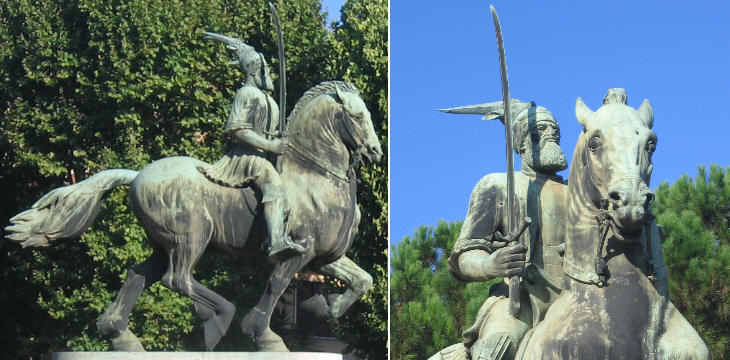
Bronze monument to Giorgio Castriota Scanderbeg by Romano Romanelli (1940).
| Mussolini used to define with military words many
of his initiatives: the reaching of self-sufficiency in wheat
production was called Battaglia del Grano (Wheat Battle); the
holding of a certain rate of exchange of the Italian lira was named
Quota 90, as if this level were a peak of a mountain which
the enemy was trying to occupy. Eventually Mussolini was a victim of
his own propaganda: because he had abolished opposition parties and
free press he ended by losing a realistic perception of the state of
the nation. The aggressive mentality which developed in Italy during the Fascist period is summarized by the monument to Scanderbeg. The statue of Marcus Aurelius was for centuries the model for all equestrian statues: the emperor who spent most of his life in the battlefields chose to be portrayed in a peaceful attitude; Emperor Augustus whose legions did not refrain from the cruellest massacres, was usually portrayed as a pacifier. Emperor Trajan was celebrated in his honorary column in the act of delivering speeches or accepting the surrender of the enemy and never in personally taking part in a fight. But Ancient Romans did not go to the movies while Romanelli and Mussolini did; Mussolini in particular promoted the Italian film-making industry and he himself indulged in poses (such as riding a white horse holding a scimitar) which showed the influence of American "Westerns". The inauguration of the statue was part of a propaganda campaign which led to the (totally unjustified) declaration of war on Greece. This occurred on October 28, the anniversary of Marcia su Roma: a choice of time which was good for selling the war as a "cakewalk", but proved to be wrong from a military viewpoint: heavy rains blocked the Italian army on the mountains of Epirus and the Greeks managed to counterattack and invade southern Albania: while in Italy October 28 is no longer celebrated, in Greece it is a public holiday and cities and towns have named 28 Oktobriou one of their main streets. |
| Anno | Political Developments | Events in Rome |
| 1941 | (Apr.) Germany invades Greece and rapidly defeats
its army: Italy is in charge of the military administration of most
of the country. (May) British troops with the support of Ethiopian rebels occupy Addis Ababa and soon after all the Italian possessions in Eastern Africa are lost. (July) Italy sends an army to support the German invasion of Russia. |
Notwithstanding the war some buildings of E.U.R. are completed. |
| 1942 | (Oct.) At El-Alamein the Allies win a battle which will eventually give them the control of Libya. | The celebrations for the XXth anniversary of Marcia su Roma are very minor and take place in a city where supplies are more and more limited. |
| 1943 | (July 9) Allied forces start the invasion of
Sicily. (July 25) Gran Consiglio del Fascismo (the highest body of the Fascist Party) calls for the resignation of Mussolini. He reports the events to the King who orders his arrest and appoints General Pietro Badoglio as new Prime Minister. (Sep.) The new government surrenders to the Allies; King Victor Emmanuel III abandons Rome and seeks refuge in Brindisi, which was already in the hands of the Allies. The army is left without clear instructions and its structure collapses in a matter of days. German troops occupy Italy and Rome: they free Mussolini who becomes the leader of a puppet state (Repubblica Sociale Italiana). |
19 luglio - un bombardamento aereo provoca vittime e distruzioni nel
quartiere di S. Lorenzo e danneggia la basilica. (Settembre) While the generals flee to Brindisi, the lower ranks of the army vainly try to prevent the occupation of Rome at Porta S. Paolo. (Ottobre) Deportation of more than a thousand Roman Jews. |
| 1944 | (Jan.) Allied troops establish a bridgehead at Anzio, but are
unable to move forward. (Jun.) Allied troops enter Rome. King Victor Emmanuel III assigns all his powers to his son Umberto. The pre-fascist political parties agree to temporarily cooperate with the Monarchy. (Aug.) Florence is freed. |
(Jan.- Mar.) Heavy bombing of Velletri, Frascati and
other small towns south of Rome. (Mar.) The Germans execute by shooting 335 civilians at a tufa cave (Fosse Ardeatine). (Aug.) End of the Allied military administration of Rome. |
| 1945 | (Apr.) Insurrection of the Italian
partigiani who free most of northern Italy before the arrival
of the Allied troops. The partigiani find Mussolini in a
retreating German convoy: he is disguised as a German soldier and
after being identified he is shot on the spot. (Dec.) Alcide De Gasperi, a Christian Democrat leader, forms the first of a series of coalition cabinets. |
Many streets and buildings associated with the
Fascist period are renamed. Roberto Rossellini shoots Roma città aperta, a dramatic movie on the life in the city during the war and the chief example of Italian neo-realism (link to Wikipedia's page Rome, Open City). |
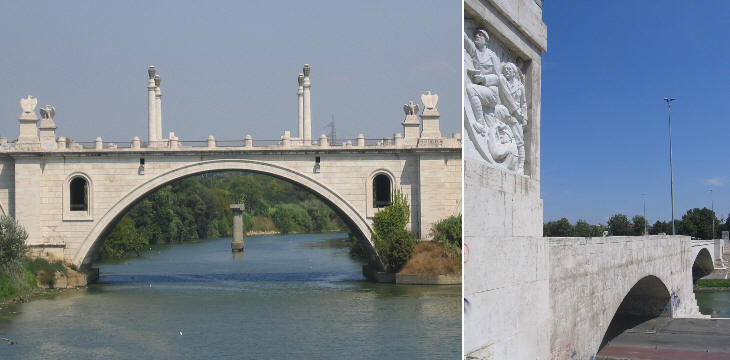
(left) Ponte XXVIII Ottobre (today Ponte Flaminio also known as Corso Francia) designed by Armando Brasini (1938-43); (right) Ponte Duca d'Aosta designed by Vincenzo Fasolo (1936-39).
| In just a few Annos Mussolini was able to create a
cult following which was unprecedented since kings and emperors lost
their aura as God's envoys and became constitutional sovereigns. In
the period 1861-1922 the Prime Ministers of the Italian Kingdom kept
a very low personal profile and some of them stressed their role as
civil servants by behaving in public as very ordinary and
respectable people. The protocol of the ceremonies emphasized the
role of the king. King Victor Emmanuel III was popular in the
country when Mussolini achieved power, but he had a shy personality
and let his Prime Minister occupy the stage while he devoted his
time to a numismatic collection. The process was so rapid that already in 1932 a large complex of buildings and sport facilities was named after Mussolini using a wording (Foro) which was reminiscent of Caesar and Augustus. While in the historic part of Rome the mark left by the Fascist period is mainly associated with demolitions, Foro Mussolini (today Foro Italico) is a summary of the architecture tendencies of the period. The development of the marshy land between Villa Madama and Ponte Milvio led to the construction of two new bridges which show these tendencies. Armando Brasini, whose personal residence is not very far from Foro Italico, was the architect whose works emphasized the monumental and rhetoric aspects of Fascism: his bridge was decorated with plenty of eagles and she-wolves, which further enriched the Roman Bestiary. Vincenzo Fasolo was the Dean of the Faculty of Architecture and his works show a bizarre assembling of architectural elements (see one of them, a chalet at Villa Torlonia). The bridge he designed at Foro Italico however shows his conversion to rationalist tendencies characterized by a lean design and the use of concrete. |
| Anno | Political Developments | Events in Rome |
| 1946 | (Maggio) Re Vittorio Emanuele III abdica formalmente
in favore del figlio Umberto II (Giugno) In Italia viene proclamata la Repubblica in seguito al referendum del 2 giugno. Viene eletta la Costituente |
The high level of inflation hits the civil servants and depresses the economy of Rome. Notwithstanding these difficulties many peasants abandon their villages and live in miserable dwellings in the suburbs of Rome. |
| 1947 | (Feb.) A peace treaty is signed in Paris: Italy
loses all colonial possessions and its eastern provinces. 300,000
refugees from Istria and Dalmatia leave their homes. (May) Split in the coalition government: Communists and Socialists are not included in the cabinet. |
Public transportation is partially reactivated. |
| 1948 | (Jan.) The Constitution comes into
force. (Apr.) General elections give a majority to the Christian Democrats. |
Vittorio De Sica shoots Ladri di biciclette, which shows the living conditions of post-war Rome (link to Wikipedia's page Bicycle Thieves). |
| 1949 | Italy is among the founders of NATO. | The announcement of the 1950 Holy Anno gives a new impetus to the reconstruction effort. |
| 1950 | With the help of the Marshall Plan gradually Italy reaches its pre-war levels of agricultural and industrial production. | Via della Conciliazione and the new Termini Railway Station are inaugurated. |
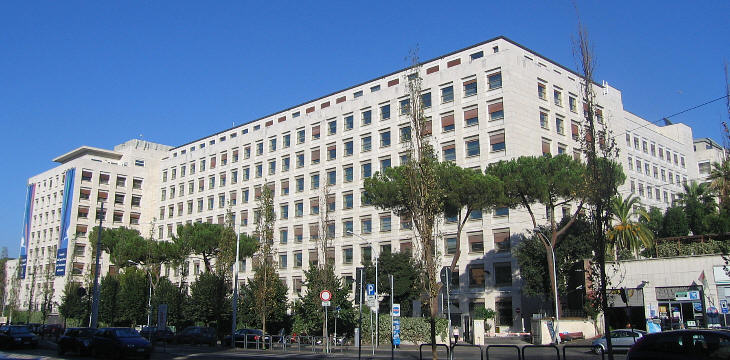
Palazzo della F.A.O. designed by Vittorio Cafiero (1938-52).
| The Cold-War between the Free World and the
Communist Block helped Italy's readmission in political society.
America and her allies supported the Christian Democrats and were
prepared to forget the role Italy had in WWII. The Soviet Union,
especially after the 1948 disagreements with Marshal Tito's
Yugoslavia, did not want to cause embarrassment to the Italian
Communist Party by adopting a vindictive policy towards Italy. A sign of this benevolent attitude was the decision by the United Nations to move to Rome F.A.O. (Food and Agriculture Organization), one of its main agencies. At the time Italy was not a member of the United Nations and so the event had a special relevance in showing the country was "coming of age" after the tutelage period which followed the war. The decision was prompted by the offer by the Italian government of a large building near Circo Massimo, initially meant to house the Ministry of Colonies. |
| Anno | Political Developments | Events in Rome |
| 1951 | A fiscal reform bill introduces Annoly tax declarations. | According to the first post-war census Rome has more than 1,600,000 inhabitants. |
| 1953 | At the general elections the Christian Democrats lose many seats: De Gasperi resigns. The cabinets of the following Annos are led by different members of that party, without a clear leadership. | When in Rome (Wikipedia link) starring Van Johnson and Roman Holiday (Wikipedia link) starring Audrey Hepburn and Gregory Peck greatly help in increasing the attractiveness of Rome as a travel destination. |
| 1954 | An agreement is reached on the country's eastern border. Trieste is assigned to Italy while the rest of the disputed territory goes to Yugoslavia. | The municipality of Rome is subservient to the wishes of building societies and in particular of Vatican-owned Società Generale Immobiliare. This will lead to the construction of a gigantic Hilton Hotel on the hill of Monte Mario. |
| 1955 | Italy is accepted as a member of the United Nations. | Rome is assigned the 1960 World Olympic Games. |
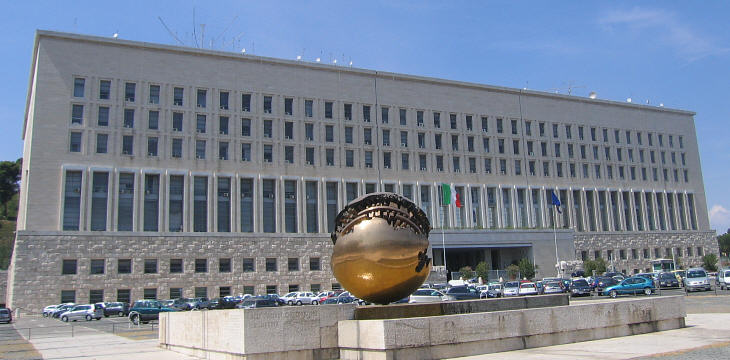
"La Farnesina" (Ministero degli Affari Esteri) designed by Enrico Del Debbio, Arnaldo Foschini and Vittorio Ballio Morpurgo (1938-56). Fountain by Arnaldo Pomodoro (1968).
| In 1951 the Government decided to complete the many
buildings which because of the war were unfinished. E.U.R. was
converted into a business district where ministries and state-owned
companies relocated their offices. The assignment of the 1960 Olympic Games helped in giving a new purpose to the facilities of Foro Italico. In 1956 the Ministry for Foreign Affairs was relocated to what should have been Palazzo del Littorio, the largest building of Foro Italico: the palace is usually called La Farnesina, because the area once belonged to the Farnese, the family of Pope Paul III. This name is also another way of making reference to the Italian Ministry of Foreign Affairs; for this reason TV news often say: La Farnesina ha detto ... to mean a statement issued by the Ministry. |


