CRONOLOGIA DEGLI EVENTI DAL 1957 A OGGI
| Anno |
Avvenimenti politici |
Eventi a Roma |
| 1957 |
France, Western Germany, Italy, the Netherlands,
Belgium and Luxembourg sign in Rome the treaty establishing a Common
Market (European Economic Community). |
Nella Sala degli Orazi e
dei Curiazi in Palazzo dei
Conservatori in Campidoglio viene firmato il Trattato di Roma. |
| 1958 |
Death of Pope Pius XII. His successor Cardinal
Angelo Roncalli chooses to be called Pope John
XXIII.
Prostitution is no longer permitted in brothels, but is
not per se a legal offence. |
One of the first acts of the new pope is to pay an
unprecedented visit to Regina Coeli, the
prison of Rome.
An area behind Terme di Caracalla
becomes a notorious place for prostitution. |
| 1960 |
The Olympic Games take place in an orderly
manner.
Italy joins the International Monetary Fund; its currency
(Lira) receives an international award for its stability.
After a decade (1950-60) of dramatic economic growth, Italy is no
longer a mainly agricultural country, but a manufacturing one.
|
Sport facilities, including Palazzo dello
Sport and Palazzetto
dello Sport, are completed in time for the games.
1960 Rome
is described by Federico Fellini's La Dolce Vita (link to
wikipedia). Paparazzo, a character of the film becomes a noun
meaning an intrusive photographer. |
| 1962 |
First government which relies on the support of
the Socialist Party which has distanced itself from the Communists.
Centre-left governments based on coalitions between Christian
Democrats and Socialists will rule the country until 1992. |
Papa Giovanni XXIII
convoca il Concilio Ecumenico Vaticano II "to open the windows of the Church so that we can see out and
the people can see in"
(sarà terminato nel 1965 da Paolo
VI).
Michelangelo Antonioni shoots L'
Eclisse at EUR, a description of
the alienation of man within the now affluent Italian society (link to
wikipedia). |
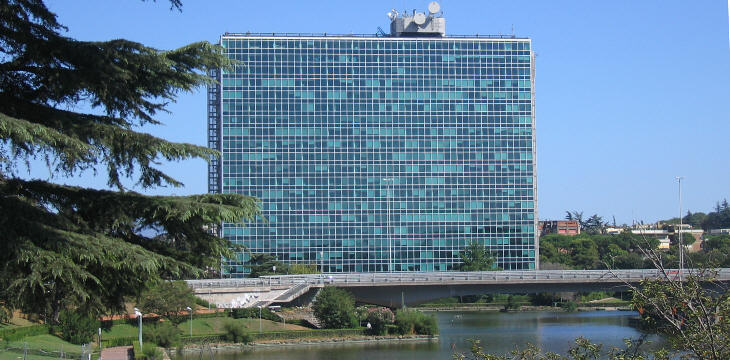
Palazzo dell'E.N.I. (1960-62).
E.N.I. is the major Italian oil company and it is
partially owned by the State. In the 1950s it established direct
relations with some oil producing countries (chiefly Iran). It
offered partnership agreements which were more favourable for them
than the usual royalty fees paid by the major international oil
companies.
Its CEO Enrico Mattei built new headquarters at EUR
which were aimed at showing an image of the company as a modern
enterprise, rather than as a public administration body. He died in
a mysterious plane crash in 1962.
This "International Style"
building designed by M. Bacigalupo/U. Ratti (appearance) and L.
Finzi/E. Nova (structure) reflected the ideals of that style which
preached a form based on the function and a total absence of
ornament. The pond which adds to the beauty of the building was paid
for by the State to house some short distance rowing competitions
during the 1960 Olympic Games. |
| Anno |
Avvenimenti politici |
Eventi a Roma |
| 1963 |
Death of Pope John XXIII. Cardinal Giovan Battista
Montini is elected pope (Pope Paul VI).
At the general elections
the Christian Democrats lose part of their support. Aldo Moro is the
cabinet leader for the following five years. |
Pope Paul VI is the last pope to be crowned. He
reduces the pomp of many ceremonies and abolishes the
flabelli (large fans made of ostrich feathers) which were
used during the pope's papal appearances in Piazza S. Pietro.
|
| 1964 |
Autostrada del Sole (Sun Highway) is
completed. It links Milan with Naples via Bologna, Florence and
Rome. Private motoring becomes the prevalent long distance mode of
travel, to the detriment of railway. |
A plan for building low rent flats is approved by
the City Council. Its implementation is very slow. |
| 1966 |
A major flood hits Florence and Venice causing
damage to some works of art. |
The eastern (larger) part of Villa Doria
Pamphilj is opened to the public. |
| 1967 |
The United Kingdom and Ireland apply for European
Economic Community membership.
The Six-Day War between Israel and
its neighbours leads to the closure of the Suez Canal. Oil products
become more expensive for Italy. |
The Vicarage of Rome is moved from Palazzo Gabrielli in
Piazza della Pigna to Palazzo del
Laterano. |
| 1968 |
At the general elections, the Socialists fare
poorly: their coalition with the Christian Democrats becomes very
shaky with frequent changes of cabinets. |
Major demonstrations at the University of Rome
which is occupied by the students.
|

"Propilei" dell'EUR (1961-65).
The original plan
developed in the 1930s provided for an "Imperial Gate" to give
access to the 1942 World's Fair area. The plan was abandoned after
WWII and the gate was replaced by identical twin buildings, called
Propilei dell'EUR, with a reference to the propylaea
giving access to Athens acropolis. However the Romans often
refer to them as the termosifoni dell'EUR as they remind the
viewer of a popular type of home radiator. The buildings were
designed by Luigi Moretti and Vittorio Ballio Morpurgo on the
assumption of a continued low cost of energy.
* * *
The writer of this page remembers when (at
the age of 20) he first started working in one of these buildings
and how much he was impressed by its facilities which included a
restaurant, a cinema, first class medical equipment, a post office,
a bank and a mall for the employees to do their shopping during
their daily break.
When (some years later) he was admitted to
the room where the Board members used to meet, he instantaneously
fell in love with Giuseppe Vasi's 1765 Grand view of
Rome which embellished one of the walls.
|
| Anno |
Avvenimenti politici |
Eventi a Rome |
| 1969 |
A bomb explodes in a bank in Milan causing 14 dead
and 90 wounded. First inquiries lead to the arrest of many
anarchists, but eventually the bombs will be blamed on neo-fascist
groups. |
Coinciding with the Milan bomb, explosions occur
in Rome at the Monument to Victor
Emmanuel II and near a bank. There are no casualties. |
| 1970 |
Statuto dei lavoratori, a comprehensive
labour law establishes additional rights for workers and trade
unions.
Divorce is admitted notwithstanding the opposition of the
Christian Democrats who promise to call a referendum to abolish it.
|
The population of Rome reaches 2,907,000
inhabitants. It is almost its peak: for a short period it will be
slightly above 3,000,000 and then it will decrease to its current
level of 2,700,000. |
| 1972 |
Luigi Calabresi, a police officer who was involved
in the first inquiries on the 1969 Milan bomb is killed by a
far-left group. |
A mentally disturbed man damages with a hammer
Michelangelo's Pietà in S. Pietro.
|
| 1973 |
In Milan a failed attempt on the life of the
Interior Minister causes the death of four and 45 wounded.
The
Yom Kippur War leads to an energy crisis which severely impacts on
the Italian economy. |
Far-left activists set fire to the house of a
neo-fascist supporter killing his two sons.
Palestinian
terrorists make an attack at Fiumicino airport killing 30.
|
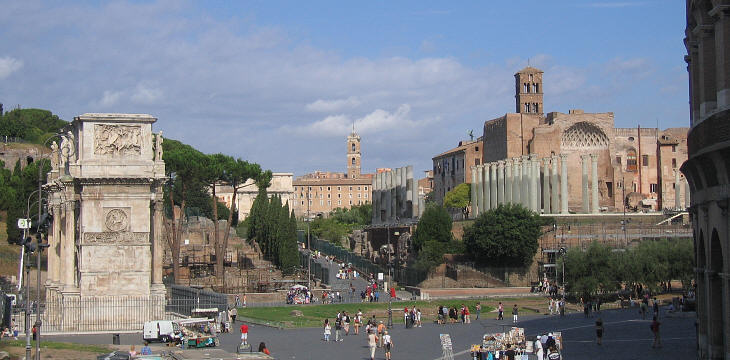
Area pedonale presso l'Arco di
Costantino
Il filosofo romano Seneca in his teachings to Emperor Nero
claimed that Ex malo bonum nullam provenit (nothing good
comes out of bad things). St. Augustine of Hippo extensively
discussed this issue in one of his sermons (LXI) and the saying
ex malo bonum from that time has entered the common language
to indicate that sometimes a negative event can carry positive
consequences.
In Italy the energy crisis, while severely damaging
the economy, led to a rethinking of the role of private
motoring.
In the 1960s cars were the emperors of Rome. The statue
of St. Paul at the top of Colonna Antonina
seemed more an attendant keeping an eye on the cars parked in the
square, than the vigorous preacher of a new faith. All the obelisks
were surrounded by parking-lots and Colosseo was a
gigantic roundabout. Shopkeepers opposed all attempts to create
pedestrian areas.
The energy crisis forced the government to
forbid the use of private cars on Sundays and the Romans gradually
rediscovered the beauty of their City. It was the beginning of a
long process which has made it very difficult for motorists to
venture into historical Rome: many streets have been closed, parking
is extremely expensive, environmental laws forbid the access to cars
not in line with anti-pollution requirements.
The photo above
shows one of the areas of Rome which was the worst affected by
motoring: cars were parked even on the wide terrace of Tempio di Romolo e
Venere and military parades
went through Arco di Costantino.
PS: the fake columns on the
terrace were a temporary (2007) decoration for a party celebrating
the Italian fashion designer Valentino. |
| Anno |
Avvenimenti politici |
Eventi a Roma |
| 1974 |
A bomb kills 8 and wounds 90 at an anti-fascist
meeting in Brescia.
The Red Brigades, a far-left group, kidnap a
judge in Genova.
A bomb placed by a neo-fascist group kills 12
and injures 44 passengers of the Rome-Brenner Express.
A
referendum called by the Christian Democrats fails to cancel the
divorce law. |
The results of the referendum in Rome were
particularly disappointing for the Christian Democrats and the
Catholic Church: 67% of the Roman voters chose to retain the law
(60% was the national average). |
| 1976 |
The Lockheed bribery scandals bring to light that
many politicians (including members of the cabinet) accepted bribes
to favour the American company.
The general elections show a
great increase of the Communist Party which was not involved in the
Lockheed scandals.
Italy experiences a very high level of
inflation. |
The Communist Party becomes the largest party of
Rome: Giulio Carlo Argan, an art historian is elected with the
support of Communists and Socialists. |
| 1977 |
The Red Brigades shoot several politicians,
journalists and magistrates in the legs. |
First Estate Romana: the
Romans show they are not frightened by terrorism.
|
| 1978 |
The Red Brigades kidnap Moro, at the time
President of the Christian Democratic Party. Four policemen
escorting him are killed. After the government's refusal to enter
negotiations, the Red Brigades kill Moro and leave his body in a car
near Palazzo Cenci
Bolognetti, the Christian Democrats' headquarters.
Morte di
Papa Paolo VI. Il nuovo papa, Cardinal Albino Luciani, sceglie di
chiamarsi col nome dei suoi due predecessori e diventa Giovanni
Paolo I. Muore dopo soli 33. The Polish Cardinal Karol Wojtyla
becomes Pope Giovanni Paolo II, the first non-Italian pope since Papa Adriano
VI.
A law allows abortion during the first 90 days of
pregnancy. |
A ceremony celebrating Moro takes place in S.
Giovanni in Laterano: in a very tense atmosphere Pope Paul VI
delivers a moving homily; the family, who blames the government for
having abandoned Moro, does not attend the ceremony, but a low key
funeral at Torrita
Tiberina, where the statesman had a countryside
residence.
Pope John Paul II gains an immediate popularity among
the Romans with his first speech: with a smile he asks for their
help in correcting his broken Italian and in doing so he makes an
evident pronunciation mistake which makes everybody laugh.
|
| 1980 |
A National Health System providing free medical
care and drugs to all citizen is introduced.
A terrorist bombing
at Bologna's Central Railway Station causes the death of 85 and
injures more than 200. It is blamed on a neo-fascist terrorist
group.
While the terrorists show they cannot be contained by
security measures, they also start to realize their political
objectives are failing: the Red Brigades are unable to raise mass
revolutions, while neo-fascist extremists discover that middle
classes are not supportive of Law and Order/Iron Fist policies
leading to authoritarian developments. |
Neo-fascists and far-left groups continue to kill
even in the very heart of Rome. At the University Vittorio Bachelet,
a professor, is killed while talking with his assistant inside the
Faculty. At the funerals one of his sons prays for his father's
killers. He expresses the general view that the terrorists are just
fanatics. |
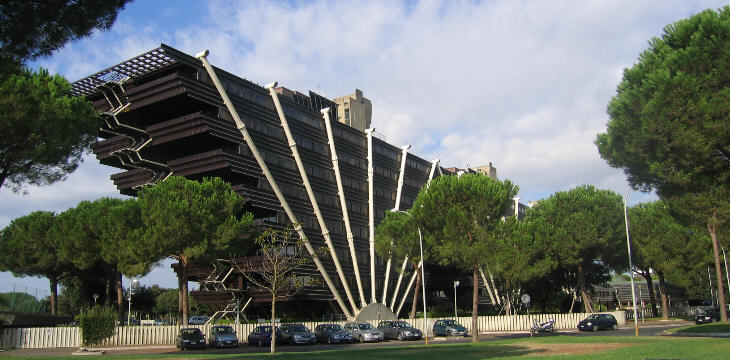
Palazzo della Esso Italiana (1978-80).
| According to many Romans it is the strangest
building of Rome. One of the explanations given for its unusual
shape is that because the area was marshy, foundations needed to be
very deep. The design chosen required this to occur on a very
limited area (the three pillars supporting the gigantic "fans").
Certainly it is the most interesting building of a new business
district which was developed in the late 1970s near Castello
della Magliana, a Renaissance papal hunting lodge on the right
bank of the Tiber. The building was designed by Julio Lafuente and
Gaetano Rebecchini. Many travellers may have noticed it because it
is next to the motorway linking the airport with Rome.
|
| Anno |
Avvenimenti politici |
Eventi a Roma |
| 1983 |
Political elections: Christian Democrats go below
33% while the Socialists slightly gain (11%): it is enough for their
leader Bettino Craxi to claim and obtain the post of premier.
|
Papa Giovanni Paolo II indice uno speciale Giubileo
per i 1950 della morte di Gesù. |
| 1984 |
Craxi firma il decreto che permette a Silvio Berlusconi
di continuare a trasmettere nonostante le decisioni contrarie di
diversi giudici. |
Forse 2,000,000 di persone si riuniscono in Piazza di
S. Giovanni in Laterano per i funerali di Enrico Berlinguer,
leader del Partito Comunista. After his death the party gradually
loses support. |
| 1985 |
|
1985 - Revisione del Trattato
Lateranense. La
Santa Sede, nella persona del segretario di stato, il cardinale Agostino
Casaroli, e il governo italiano, nella persona del presidente del Consiglio Bettino
Craxi, procedettero alla revisione del trattato, con l'innovazione di non
considerare più il cattolicesimo religione ufficiale dello stato italiano. |
| 1986 |
Italy takes part for the first time in the yearly
G7 meetings. Notwithstanding this recognition, the deficit of the
public sector weakens the economic relevance of Italy.
|
Papa Giovanni Paolo II visita la Sinagoga
di Roma, the first pope to do so. |
| 1989 |
A cabinet crisis lasts more than two months due to
a feud among Christian Democrat politicians while the risk of
bankruptcy looms on the horizon. |
The Christian Democrat Mayor of Rome è costretto a
dimettersi a causa del suo coinvolgimento in the mishandling of cafeteria
services in the schools. |
| 1990 |
The Communist Party approves a plan for changing
direction and abandoning its traditional allegiance to
Marxism. |
The Soccer World Championship takes place in Italy
with the final game in Rome.
|
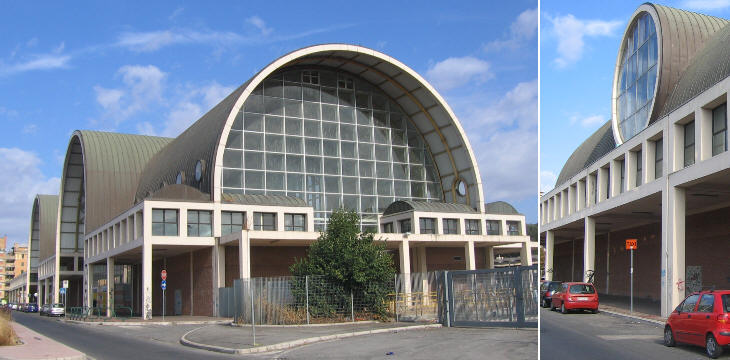
Air Terminal Ostiense.
| The World Soccer Championship was the occasion for
an unprecedented waste of public money because many facilities were
enlarged or rebuilt. In Rome the government decided to establish a
railway link between Rome and its airport near Fiumicino (ancient
Porto). It was a link much needed in view of the ever growing
number of passengers flying to Rome. It damaged however the
interests of the taxi drivers, a very powerful guild. They used
their electoral vote to support a party (at the time the Socialist
one) and in this circumstance they made their voice heard. The
railway link was based on just three trains per hour and with a gap
of 30 minutes between two of them: it was soon evident the service
did not meet the needs of businessmen in a hurry, while many
tourists did not know about this new facility which was poorly
advertised at the airport. A large Air Terminal was built at
Ostiense, the departing railway station: it had check-in facilities
and a mall of shops: these after a few months run out of business
and closed: the use of the Air Terminal was discontinued a few years
later. It now stands as a monument to the poor judgement and courage
of Italian politicians. The building was designed by Gae Aulenti, an
architect who had acquired an international reputation for her
restructuring of the Parisian Gare d'Orsay, which turned the old
railway station into a museum. Later on she worked at doing the same
at Scuderie del
Quirinale. |
| Anno |
Avvenimenti politici |
Eventi a Roma |
| 1992 |
A Milan an investigation (eventually known as
Mani Pulite - Clean Hands) starts into an alleged case of
bribery involving a Socialist in charge of a historical home for the
old. It gradually leads to discovering widespread
corruption.
Speculative attack against the Italian Lira; the
government is forced to introduce additional taxes in a situation of
emergency.
The Sicilian Mafia kills two high magistrates and
their escorts with explosive devices.
All these events lead
Italians to fear a collapse of the country: the blame is laid on the
men in power. |
The bribing system is not limited to Milan:
officers of several public bodies are arrested for bribes associated
with works at the University, at the Fiumicino Airport and with the
administration of blocks of flats owned by State institutions.
|
| 1993 |
Mani Pulite finds that many politicians,
including Bettino Craxi, are involved in corruptive practices. The
situation is so difficult that Carlo Azeglio Ciampi, President of
the Bank of Italy, is asked to lead an emergency cabinet. The
electoral law is modified in an attempt to promote stable
coalitions.
The assumed godfather of the Sicilian Mafia is
arrested and jailed for life. |
The Socialist Mayor of Rome is forced to resign
because a member of his team confesses to accepting bribes.
An
explosive device placed by the Sicilian Mafia damages the portico of
S. Giorgio al
Velabro.
Elections for the Mayor of Rome see two opposed
coalitions: one led by Gianfranco Fini leader of a neo-fascist party
and the other by Francesco Rutelli supported by centre-left parties.
Berlusconi makes his first political statement in support of Fini.
Rutelli is the new Mayor of Rome. |
| 1994 |
Berlusconi fonda un partito which gains many seats
at the general elections: he leads a coalition cabinet with Lega
Nord, a movement calling for the independency of northern Italy and
with Fini's party. After a few months the coalition splits and
Berlusconi resigns. |
Viene rubato il Bambinello
dell' Ara Coeli.
Berlusconi sets his private Roman
residence in Via dell'Anima (near S. Maria
dell'Anima) and later on at Palazzo Grazioli. |
| 1995 |
Fini "cleans" his party from its neo-fascist
origin.
Centre-left parties design as their candidate for
premiership Romano Prodi, a university professor in Economics.
A
cabinet led by Lamberto Dini, a former Director of the Bank of Italy
introduces significant changes to the pension system by reducing its
benefits. |
The construction of a mosque is
completed.
Prima Maratona di Roma. |
| 1996 |
La coalizione guidata da Prodi vince le elezioni
politiche. |
S. Giorgio al Velabro is restored to its pristine
appearance. |
| 1998 |
Italy implements a tight budget policy and is
accepted among the founding participants in the Euro, a common
European Currency which will replace the national ones. A far-left
party withdraws its support and the cabinet falls. Prodi in 1999 is
appointed Chairman of the European Commission. |
Palazzo
Altemps, a fine Renaissance palace is open to the public; it
houses the Ludovisi collection of ancient statues. The relocation of
the collection is part of a wider program of improvements at Museo
Nazionale Romano. |
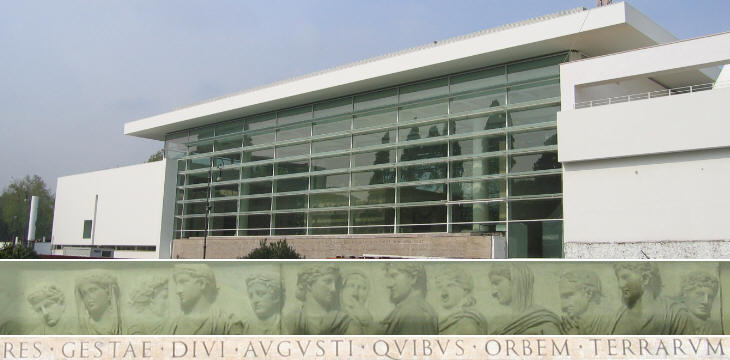
Ara Pacis
Augustae
The demolitions carried out during the 1930s led to
discovering some fragments of Ara Pacis Augustae. The altar
celebrated the peace during the rule of Emperor Augustus
and other parts of it had been found in the previous centuries. It
was decided to reconstruct the altar and a building housing it was
placed next to Mausoleo di
Augusto. Over the years it became evident that the building (a
sort of gigantic shop window) did not ensure appropriate protection
from humidity and pollution.
In 1995 the City of Rome decided to
build a new container for Ara Pacis Augustae and a project by
Richard Meier was selected.
The completion of the building was
stopped by a junior member of the Berlusconi government (who came
back to power in 2001) and so a matter of technical/artistic
judgement was thrown into the political arena. Notwithstanding the
opposition of the national government, local authorities eventually
managed to complete the new container in 2006.
The local leaders
of Berlusconi's alliance have promised that if ever they take power
in Rome, they will pull it down. |
| Anno |
Avvenimenti politici |
Eventi a Roma |
| 2000 |
Poor showing of the centre-left coalition at the
regional elections. |
Il
Giubileo del 2000 attira a Roma folle immense di pellegrini.
Angels
and Demons, a novel by Dan Brown's portrays an unusual Rome.
Chiesa
di Dio Padre Misericordioso is among the churches built for the
Jubilee. It was designed by Richard Meier. |
| 2001 |
La coalizione guidata da Silvio Berlusconi vince le
elezioni generali.
Violenti scontri tra la polizia e i
manifestanti al G8 di Genova. |
At the local elections Rome confirms the
centre-left majority. |
| 2002 |
In 12 paesi europei viene introdotto l'Euro.
Proposed labour laws at easing firing procedures are
met with strong trade unions opposition. Eventually the government
gives up its proposal. |
Major rally at
Circo Massimo against the proposed changes to firing
procedures.
Parco della
Musica, a multi-function complex designed by Renzo Piano is
completed. |
| 2003 |
Italy sends 3,000 troops as peacekeeping force in
southern Iraq; a suicide bombing kills 20 Italians. |
(Feb.) Major rally against the
war.
(Oct.) First Roman Sleepless Night.
|
| 2005 |
Morte di Papa Giovanni Paolo II. Il suo successore, il
Cardinale Joseph Ratzinger, sceglie di chiamarsi Benedetto XVI.
|
Funerary ceremonies see the participation of
immense crowds (see a page on the papal
transition). |
| 2006 |
La coalizione di centro-sinistra guidata da Romano Prodi vince di poco le elezioni
politiche. |
Crowds cheer
the Italian Soccer Team after they win the World Championship.
|
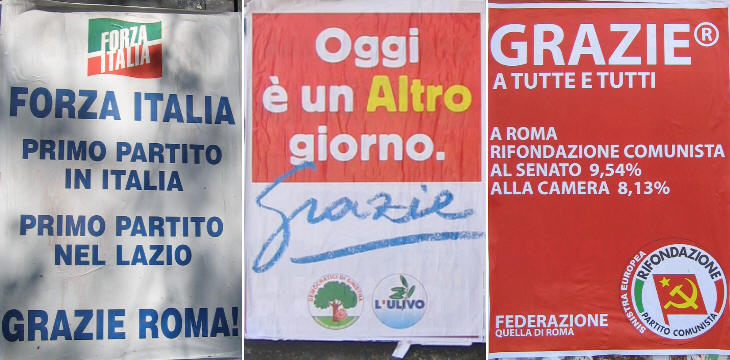
Elezioni politiche del 2006: manifesti che ringraziano i Romani per i loro voti.
Alla fine delle Elezioni Politiche del 2006 tutti erano felici:
quelli della coalizione vincente (Prodi) perché non avevano fatto poi così ranto per tornare al potere;
quelli della coalizione perdente (Berlusconi) perché avevano perso non tanto quanto gli exit poll
avevano predetto: così nessun leader di partito pensò che fosse giunto il momento di ritirarsi.
12 partiti avevano rappresentanti eletti alla Camera dei Deputati, ma essi rappresentavano
ben 18 partiti politici perché in vista delle elezioni alcuni partiti si erano uniti: due di essi brigarono
assai per ottenere lo 0.7% dei voti e tuttavia i loro leader non pensarono minimamente di rassegnare le dimissioni.
Tale situazione era stata favorita dal governo uscente, in predicato di perdere le elezioni,
proprio per impedire alla coalizione di Prodi di poter governare, ma aveva radici antiche
nella tradizione nazionale di divisione anziché di unità.
* * *
Alla fine di questa Storia è bello ricordare ai lettori
che secondo una leggenda la Città durerà fintantoché
un grano d'oro sarà visibile sul bronzo della statua dell'Imperatore
Marco Aurelio. Come si vede dall'immagine usata come sfondo di questa pagina,
Roma non è certo alla fine della sua storia.
| |


