Introduzione
Queste pagine mostranobrevemente l'evoluzione delle Tombe dei Papi dal
XIII secolo al XIX. In molti casi è difficile ottenere delle buone foto
senza un equipaggiamento professionale, ecco perché spesso saranno mostrati solo dei dettagli.
In molti casi i monumenti non sono il luogo dell'effettiva collocazione della salma
del papa, andata perduta o conservata altrove.
I cuori e le altre parti interne (praecordia) sono conservat nella chiesa dei SS. Vincenzo e
Anastasio.
Il luogo di sepoltura di alcuni papi medievali fu scoperto durante il restauro
di S. Giovanni in Laterano, di S. Maria Maggiore e di altre chiese: questo portò alla
costruzione di monumenti Rinascimentali o Barocchi loro dedicati.
Un esempio è il Monumento di Sergio IV (1009-12)
disegnato da Francesco Borromini in S. Giovanni in Laterano e decorato con i simboli araldici
(sei monti e una stella) di Alessandro VII
(1655-67). Di questi monumenti non si parla in queste pagine.
Alcuni monumenti furono progettati anche se non realmente completati mentre il papa era in vita
(Bonifacio VIII, Giulio II, Sisto V, Paolo V, Urbano VIII,
Clemente IX sono tra i papi che si preoccuparono del proprio monumento funebre);
altri monumenti furono commissionati dal Cardinal Nepote (cioè un nipote del papa
che lo assisteva nel governo dello Stato della Chiesa) subito dopo la morte del papa.
In alcuni casi infine il monumento fu disegnato molti anni dopo la morte del papa.
Pertanto, se quasi sempre vi è stretta correlazione tra la morte del papa e
la realizzazione del suo monumento funebre, vi sono tuttavia eccezioni notevoli, ed
è per questo che nella pagina iniziale i monumenti sono ordinati cronologicamente.
Molti monumenti sono in San Pietro, ma non tutti: quando la vecchia
basilica fu demolita alla fine del XVI secolo furono spostati in altre chiese di Roma;
altri furono collocati altrove perché il papa aveva un affetto particolare
per una chiesa. In conclusione, ci sono più di dieci chiese che ospitano monumenti
funebri di papi.
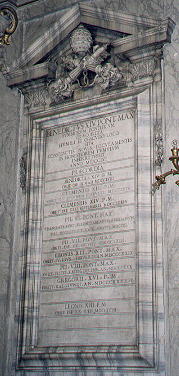
Inscription listing the popes whose
praecordia are kept in SS. Vincenzo e Anastasio and XVIIth century
Monument to Sergius IV (1009-12) in S. Giovanni in
Laterano.
Sarcofagi
During the first millennium A. D. the role of the pope was almost
entirely confined to religious matters and although he had a significant
role in the political life of Rome and took decisions such as building
walls and castles there is no evidence of monuments to the popes. The
first pope who deemed necessary to emphasize his role by means of a
monument was Anastasius IV (1153-54) who wanted to be buried in a large
IVth century porphyry Roman sarcophagus, found in the Ruins of
Sepolcro di S. Elena and moved by him to S. Giovanni in Laterano (now
in the Vatican Museums).

Grande sarcofago in porfido del IV secolo simile a quello usato da Anastasio IV
come monumento (Musei Vaticani)
His example was followed by other popes. When the monuments to the
popes developed a more complex structure, the use of a Roman sarcophagus
was not totally abandoned, but it was restricted to the popes who had been
in office only for a matter of days and whose relatives did not have the
financial means to erect a monument. During the Renaissance many Roman
sarcophagi were recovered and this led to an ample choice of sarcophagi
with a suitable (non pagan) decoration.
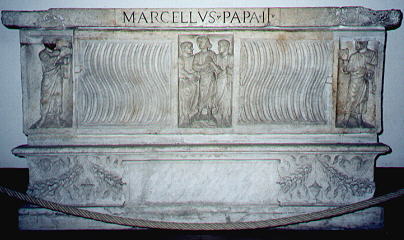
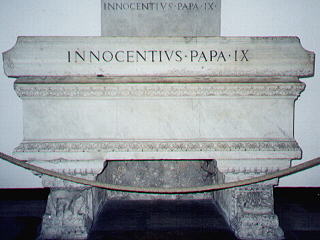
Sarcofagi usati nel XVI secolo per Marcello II (1555) e Innocenzo IX (1591)
nelle Grotte Vaticane
Gisants
The first monument to the pope
which was not just the assemblage of Roman sarcophagi followed a Gothic
pattern (the Pope - Clemens IV (1265-68) - was French) and it consisted in
a statue of the pope lying down on a sarcophagus under a Gothic arch.
These monuments are called gisant which means in French Statue
d'un personnage couché. The gisant pattern was soon embellished
with mosaic decorations made of the various marbles and stones which were
largely available in Rome.
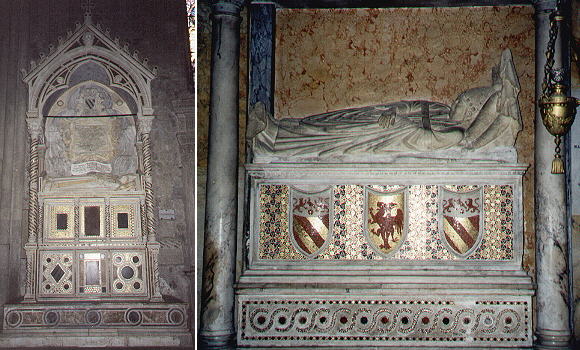
Gisants di Adriano V (1276) di
Arnolfo di Cambio in S. Francesco (Viterbo) e di Onorio IV (1285-87)
in S. Maria in Aracoeli
Many gisant monuments were erected in S. Pietro Vecchio and
were moved to other churches when the old basilica was pulled down (the
Monument to Honorius IV shown in the image here above was moved to S.
Maria in Aracoeli in 1545). Other monuments were completely lost or only
the statue of the pope was saved. The statue of Bonifatius VIII
(1294-1303) is of particular interest because the pope himself decided to
be portrayed as a (relatively) young man and with the papal insignia (in
particular the elaborated crown). The statue of Nicholas V (1447-55) is
slightly turned to the left to improve its visibility.
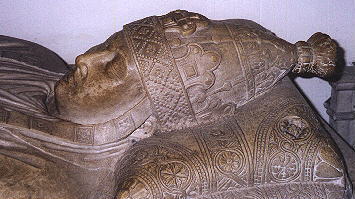
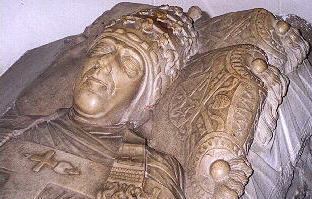
Particolari dei monumneti a Bonifacio VIII e a Nicolò V nelle Grotte Vaticane
Antonio del Pollaiolo
Some deviations from the gisant pattern were experimented in the
XVth century in part because of the great development in the use of bronze
which had occurred in Florence with Lorenzo Ghiberti. The Monument to
Martinus V (1417-31) by the Florentine sculptor Simone di Giovanni Ghini
in S. Giovanni in Laterano is made of a large bronze plate which renovated
the tradition of the medieval marble plates used in the churches to
indicate where the rich were buried. The Monuments to Pius II (1458-64)
and to his nephew Pius III (1503), previously in S. Pietro Vecchio and
moved to S. Andrea della Valle in 1614, both show the statue of the pope
framed in a complex decoration which includes other statues and reliefs.
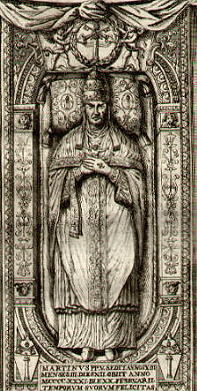
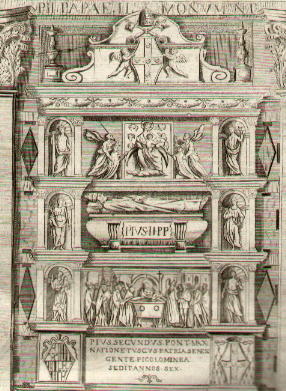
Monumenti a Martino V in S. Giovanni in Laterano e a Pio II in S. Andrea della
Valle
The large and low bronze Monumento a Sisto IV (1471-84) di Antonio del Pollaiolo was given a unique structure as it was designed for being located at the center of a chapel. The reliefs around the statue of the pope show the Seven Virtues (*) (inner circle) and ten allegories of Art and Science (outer circle). The Monument to Sixtus IV brought to Antonio del Pollaiolo the commission for the Monument to Innocentius VIII (1484-92), which became a turning point in the history of the monuments to the popes as it portrayed the pope both lying down in the traditional gisant posture and seated on his throne in the act of blessing.
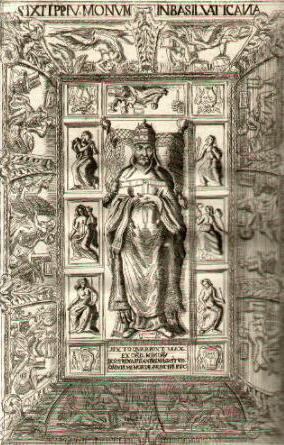
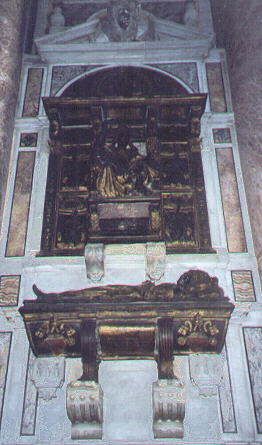
Monumenti a Sisto IV e Innocenzo VIII in S. Pietro
XVIth Century Developments
In the XVIth century the monuments to the popes abandoned the
gisant posture and showed the pope seated on his throne in the act
of blessing. A change was introduced in the Monuments to Sixtus V
(1585-90) and Paulus V (1605-21) who preferred to be portrayed in the act
of praying on their knees (they both were alive when the monuments were
completed and this explains why they preferred a humble posture). The
statue of the pope was usually located in a niche at the center of a
complex structure resembling a triumphal arch and decorated with other
statues and reliefs. The four Monuments to the popes in Cappella Sistina
(Pius V and Sixtus V) and in Cappella Paolina (Clemens VIII and Paulus V)
in Santa Maria Maggiore show the final (and very expensive) development of
the Renaissance pattern of monument.
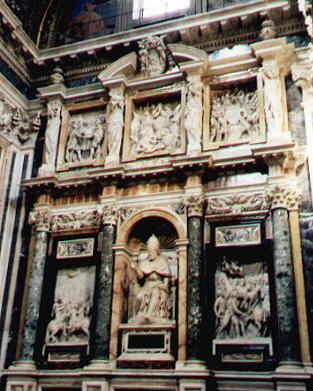
Monumento a Clemente VIII (1592-1605) progettato da Flaminio Ponzio (1611) in S. Maria Maggiore
(*) 3 virtù teologali (Fede, Carità e Speranza) e 4 virtù cardinali (Prudenza, Giustizia, Fortezza e Temperanza).
Torna alla Lista delle Tombe e Monumenti Funebri dei Papi
Vai ai Monumenti Funebri Barocchi e Neoclassici
Vai al Capitolo 5 del Libro di Lanciani Tombe di Papi per avere qualche informazione anche su quelle antiche
Note: l'immagine dello sfondo-pagina è un particolare del Monumento a Leone XI di Alessandro Algardi in S. Pietro.