|
|
PORTE PAPALI |
|
|
Questa pagina ha a che fare con le porte di alcune città dello Stato Pontificio.
Le porte di Roma sono trattate in altre pagine. Military, security and taxation
reasons justified the need to provide each little town of the state with
walls. Bevagna
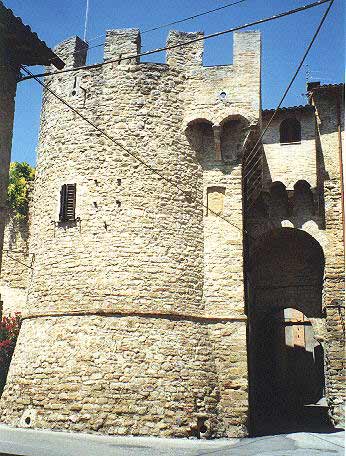
Nel cuore dell'Umbria, celebrated for its pastures and its picturesque appearence, Bevagna conserva quasi due chilometri di mura erette nel XIII secolo. La porta detta "Torre dei Molini" ha un piccolo stemma di Innocenzo VIII (Giovan Battista Cybo, 1484-1492) che si può vedere nello sondo di questa pagina. Civita Castellana
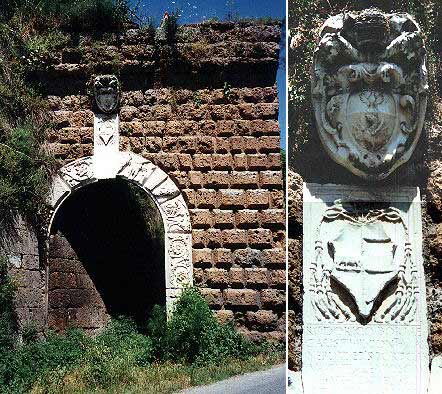 Civita Castellana was the site of Falerii, the town of the
Falisci, which was captured by Camillus in B. C. 396. The Romans
destroyed Falerii and founded Falerium Novum in the plain, but in the
Middle Ages the inhabitants went back to the old, better protected site.
The little town was given by Sixtus IV to Cardinal Rodrigo Borgia, who
built a circle of walls and on the top of the hill a fortezza, che fu ampliata da Giulio II e Leone X
e usata per secoli come Prigione di Stato. The strength of the fortress eventually made the walls
redundant and they were pulled down with the exception of the main gate
decorated with remains of a Roman sarcophagus. Lo stemma del Cardinal Borgia
(Alessandro VI) è sovrastato da quello di Paolo V aggiunto più di un
secolo dopo.
Anagni
Anagni is also called "la Città dei Papi" because of the four popes
who were born here (Innocentius III, Gregorius IX, Alexander IV and
Bonifatius VIII, all between 1198 and 1303) and who made it prosperous.
The walls were largely restored by Pius IV in the XVIth century. Above you
can see Porta S. Maria, which shows a resemblance to Porta Pertusa. You may
wish to follow Ferdinand
Gregorovius' walk in Anagni.
Visso
Visso is a small town in Val Nerina commanding one of the main roads
crossing the Appennines. Its medieval walls were restored by Gregorius
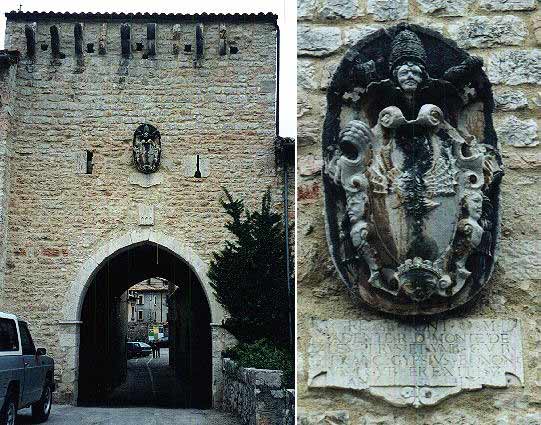
XIII in the late XVIth century. The coat of arms on the gate named Porta
di Via Lata, is somewhat unusual maybe because its architect had hearsay
knowledge of the coats of arms being sculpted in Rome.
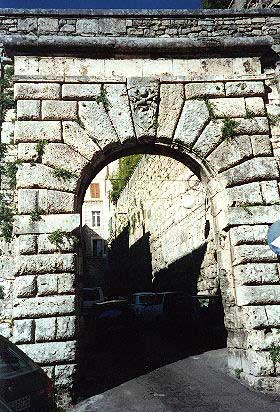
 Perugia, the capital of Umbria, built on several hills, had a very long and tortuous ring of walls. With the growth of the population new peaks were included in the walls and new gates opened. Above Porta S. Costanzo erected under Sixtus V, an addition to the existing walls to protect the church of S. Pietro de' Casinensi. Viterbo
Viterbo was
the central point of the extensive grant called the "patrimony of St.
Peter" and is frequently mentioned in history as the residence of the
popes and the scene of the papal elections in the XIIIth century. Here the
popes felt more secure than in Rome. The walls were built at that time.
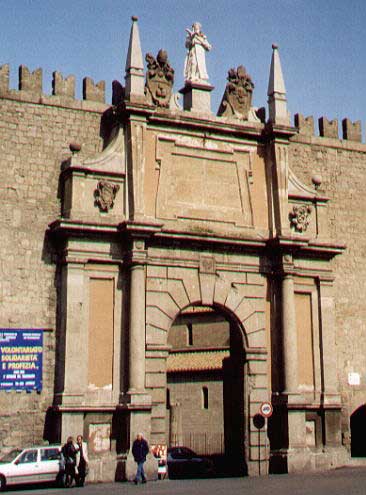
The most important gate is Porta Romana rebuilt on the occasion of a visit
of Innocentius X in 1653 and embellished under Clemens XI in 1705. Between
the coats of arms of the popes, the statue of S. Rita, patroness of
Viterbo.
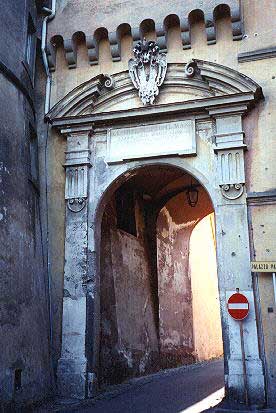 Castelgandolfo, splendidly situated high above the Lake of Albano, venne in possesso dei papi nel 1596. Pope Urbanus VIII erected a large Papal palace and Castelgandolfo became (and still is) a favourite summer resort of the popes. The access to the central square is controlled by this elegant XVIIIth century gate with the coat of arms of Clemens XII. Montefiascone e Valentano 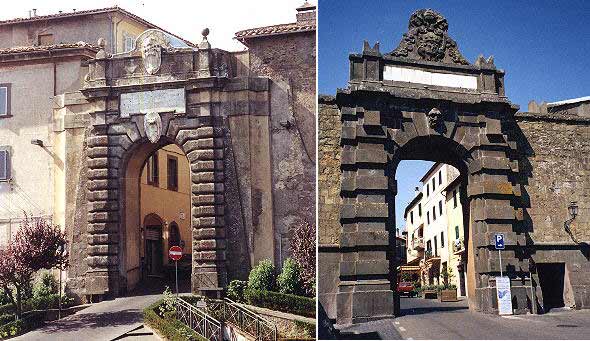 Montefiascone e Valentano sono due cittadine sulle colline che circondano il Lago di Bolsena. entrambe ebbero nuove porte nel '700. Porta Viterbese (a sinistra) a Montefiascone fu eretta sotto Benedetto XIV in 1744. La porta principale di Valentano (a destra), nell'antico Ducato di Castro fu costruita nel 1779 sotto Pio VI. |