|
PIEDI ROMANI E SANDALI |
 |
 |
|
Nell'agosto del 2003 la stampa riportò la scoperta in Inghilterra della statua di un legionario romano con dei calzini sotto i sandali. La BBC accusò i Romani di aver introdotto in Gran Bretagna questo appalling esempio di cattivo gusto (specialmente quando i calzini sono di un colore che dà nell'occhio, per esempio di un blu acceso con sandali scuri). Questa pagina parla di alcuni aspetti della rappresentazione dei piedi e calzature nell'antichità (i calzini sono rigorosamente banditi).
Secondo gli anatomisti tre quarti della popolazione hanno il cosiddetto piede Egiziano, caratterizzato dall'alluce più lungo del secondo dito, 1/6 of the population have a so-called Greek foot where the great toe is shorter than the second toe, while the rest of the population have a square foot where the great toe has the same length as the second. Il riferimento all'Egitto è dovuto al fatto che nei dipinti Egiziani (dove di solito i piedi sono rappresentati di profilo) il ditone appare più lungo del secondo dito. Il riferimento alla Grecia è dovuto al fatto che le statue Greche mostravano piedi col secondo dito più lungo dell'alluce. Nonostante l'anatomia prevalente, quasi tutte le statue Romane, spesso copie di originali Greci, hanno piedi Greci. Non è facile trovare una statua con un chiaro piede Egiziano, perché anche le statue Egiziane hanno piedi Greci. In ogni modo, forse per caso, forse di proposito, la colossale statua del Nilo in Piazza del Campidoglio fu restaurata sostituendo il piede mancante con un piede evidentemente Egiziano. Gli artisti Neoclassici avevano una tale ammirazione per la Grecia che le loro statue hanno piedi Greci che rasentano la deformità. Rinaldo Rinaldi, allievo del Canova, fornì un esempio perfetto di questa tendenza nella sua statua della Fede in S. Marcello.
Greek gods as a rule were portrayed barefoot even when they wore
elaborate dresses. However there were some exceptions: Diana, the huntress
goddess, wore proper footwear, and often other gods portrayed while
hunting were not barefoot. The presence of snakes maybe influenced the
decision of providing both Athena and Aesculapius with a means to tread on
them (in case of need). While Aesculapius has stout sandals, Athena has a
much lighter model.
Roman Emperors, especially for their eastern subjects, promoted themselves as having a divine nature. Augustus paid a lot of attention to his own iconography. In the statue shown above he is portrayed wearing an elaborate cuirass over an even more elaborate toga, but barefoot. To the eyes of a today's western viewer who associates being barefoot with being uncivilized, the feet of Augustus do not seem to match the rest of the statue. But walking barefoot was a privilege of the ancient gods, who clearly were not affected by thorns and scratches. The association between being barefoot and having a superhuman nature influenced also Renaissance and Baroque artists. Michelangelo's Sibyls and Prophets in the Sistine Chapel are all fully dressed, but at the same time barefoot and Bernini's Santa Teresa is barefoot too.
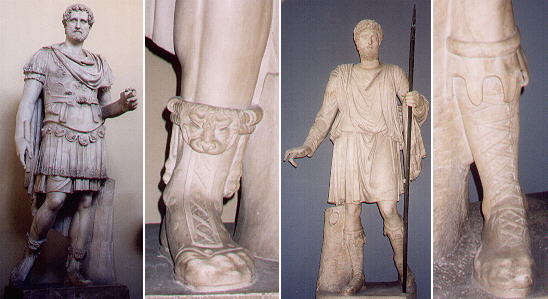
Notwithstanding the fact that gods and emperors were usually barefoot, there are enough examples of Roman footwear to say that Ferragamo and Gucci and in general the good design of Italian shoes have very ancient roots. Roman military and hunters could parade with elaborate boots (note: the statue of the hunter has a head belonging to another statue).
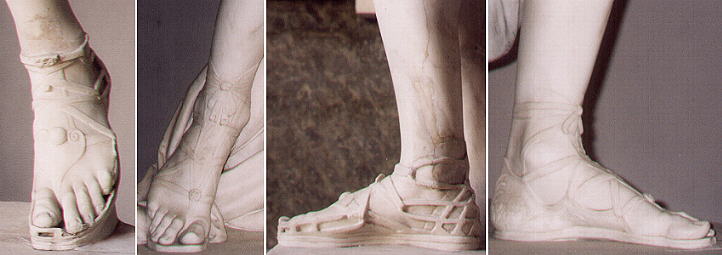
Sutor, ne supra crepidam (Shoemaker, not above the sandal) is a sentence by Apelles, the famous Greek painter, telling a shoemaker (who after having made a correct observation on how Apelles had painted a sandal, wanted to advise on other matters), not to talk about things he had no knowledge. The anecdote was reported by Plinius and the sentence became very popular. The images above show maybe the most celebrated sandals of the Vatican Museums belonging respectively to the Apollo del Belvedere, a Roman copy from a Greek bronze original, perhaps the ancient masterpiece which Renaissance artists admired most, and Perseus a statue by Antonio Canova which replaced the Apollo del Belvedere when this statue was taken to Paris by Napoleon in 1800. Canova's Perseus, notwithstanding the different subject was inspired by the Apollo del Belvedere. I wonder if a shoemaker would not have advised Canova about the sandals of Perseus being fitter for a dancer than a warrior.
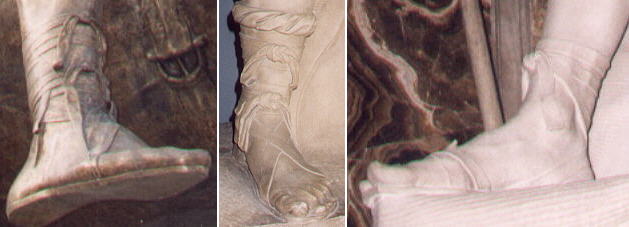
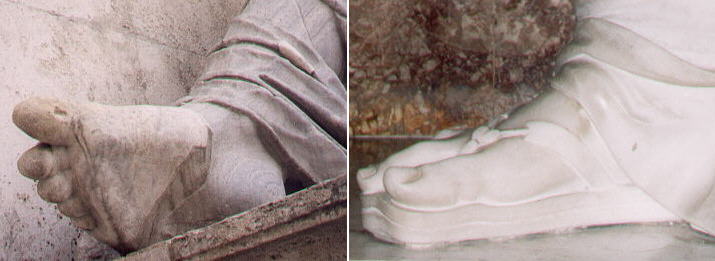
Another comparison between ancient and modern sandals is offered by the statues of Marcus Aurelius in Piazza del Campidoglio and Bernini's S. Longino in S. Pietro. The sandal of the Roman emperor shows that the sole is held only by a couple of straps. As I had some doubts on this design I checked on other statues and I found that actually this kind of sandals had only one couple of straps holding the sole. Bernini had surely in mind Marcus Aurelius' sandals in the design of S. Longino, but he preferred to provide the Roman centurion with a sandal with two couples of straps, thus ensuring a firmer adherence of the sole to the foot.
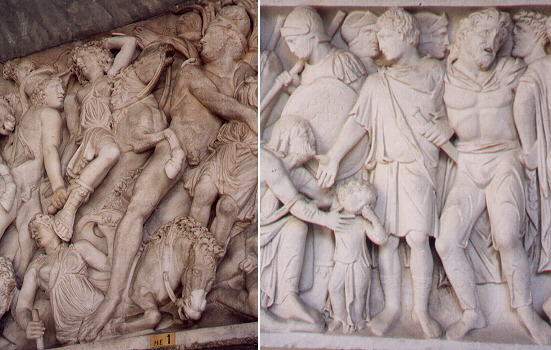
Many ancient reliefs showing fights often portrayed one side barefoot and the other not. In the relief showing a battle tra i Greci (comandati da Achille) e le Amazzoni, la nudità è un segno di superiorità, mentre nel rilievo raffigurante Romani e Germani la superiorità dei primi is enhanced by their being fully dressed and wearing boots.
Il particolare sopra mostra un esempio dove le dita dei piedi si allineano all'emozione espressa dalle dita della mano. Comprimendo le dita dei piedi in scarpe chiuse sin dall'infanzia, noi castriamo definitivamente la nostra personalità! |
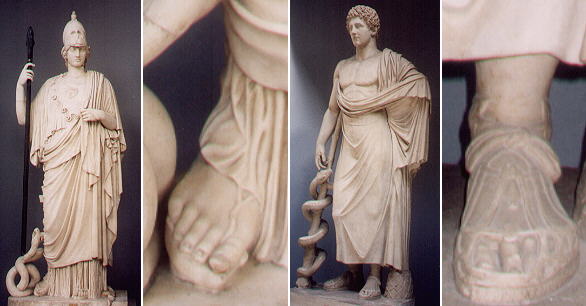 Athena ed Esculapio - Musei Vaticani
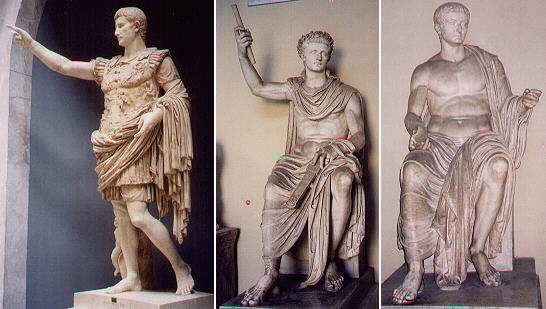 Barefoot Emperors: Augustus,
Tiberius, Claudius (?) - Vatican Museums
Barefoot Emperors: Augustus,
Tiberius, Claudius (?) - Vatican Museums